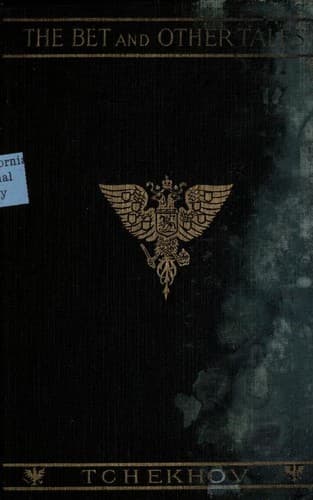
The Bet, and other storiesChekhov, Anton Pavlovich
General
The Bet, and other stories
Chekhov, Anton Pavlovich
Russian fiction -- Translations into English; Short stories, Russian -- Translations into English
In my present state of mind five minutes are enough for him to bore
me as though I had seen and listened to him for a whole eternity. I
hate the poor man. I wither away beneath his quiet, even voice and
his bookish language. His stories make me stupid.... He cherishes the
kindliest feelings towards me and talks to me only to give me pleasure.
I reward him by staring at his face as if I wanted to hypnotise him,
and thinking “Go away. Go, go....” But he is proof against my mental
suggestion and sits, sits, sits....
While he sits with me I cannot rid myself of the idea: “When I die,
it’s quite possible that he will be appointed in my place.” Then my
poor audience appears to me as an oasis where the stream has dried,
up, and I am unkind to Piotr Ignatievich, and silent and morose as if
he were guilty of such thoughts and not I myself. When he begins, as
usual, to glorify the German scholars, I no longer jest good-naturedly,
but murmur sternly:
“They’re fools, your Germans....”
It’s like the late Professor Nikita Krylov when he was bathing with
Pirogov at Reval. He got angry with the water, which was very cold,
and swore about “These scoundrelly Germans.” I behave badly to Piotr
Ignatievich; and it’s only when he is going away and I see through the
window his grey hat disappearing behind the garden fence, that I want
to call him back and say: “Forgive me, my dear fellow.”
The dinner goes yet more wearily than in winter. The same Gnekker,
whom I now hate and despise, dines with me every day. Before, I
used to suffer his presence in silence, but now I say biting things
to him, which make my wife and Liza blush. Carried away by an evil
feeling, I often say things that are merely foolish, and don’t know
why I say them. Thus it happened once that after looking at Gnekker
contemptuously for a long while, I suddenly fired off, for no reason at
all:
“Eagles than barnyard-fowls may lower bend;
But fowls shall never to the heav’ns ascend.”
More’s the pity that the fowl Gnekker shows himself more clever than
the eagle professor. Knowing my wife and daughter are on his side he
maintains these tactics. He replies to my shafts with a condescending
silence (“The old man’s off his head.... What’s the good of talking to
him?”), or makes good-humoured fun of me. It is amazing to what depths
of pettiness a man may descend. During the whole dinner I can dream how
Gnekker will be shown to be an adventurer, how Liza and my wife will
realise their mistake, and I will tease them--ridiculous dreams like
these at a time when I have one foot in the grave.
Now there occur misunderstandings, of a kind which I formerly knew only
by hearsay. Though it is painful I will describe one which occurred
after dinner the other day. I sit in my room smoking a little pipe.
Enters my wife, as usual, sits down and begins to talk. What a good
idea it would be to go to Kharkov now while the weather is warm and
there is the time, and inquire what kind of man our Gnekker is.
Public-domain text, read in full here on John Shaqi.
Reviews
Reviews
No reviews yet
Be the first to share your thoughts on this work.
Join the Discussion
Join the discussion
Sign in to leave a comment or review.
Sign InorCreate an account