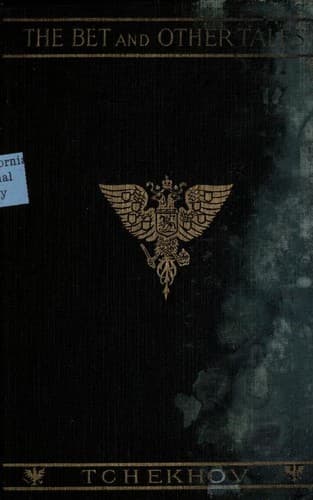
The Bet, and other storiesChekhov, Anton Pavlovich
General
The Bet, and other stories
Chekhov, Anton Pavlovich
Russian fiction -- Translations into English; Short stories, Russian -- Translations into English
He was silent for a while, passed his hand over his forehead trying to
recall the words, and began to sing in a loud voice and so well that
the passers-by looked back.
“Here, long ago, came free, free love to me”...
All three went into a restaurant and without taking off their coats
they each had two thimblefuls of vodka at the bar. Before drinking the
second, Vassiliev noticed a piece of cork in his Vodka, lifted the
glass to his eye, looked at it for a long while with a short-sighted
frown. The medico misunderstood his expression and said--
“Well, what are you staring at? No philosophy, please. Vodka’s made to
be drunk, caviare to be eaten, women to sleep with, snow to walk on.
Live like a man for one evening.”
“Well, I’ve nothing to say,” said Vassiliev laughingly, “I’m not
refusing?”
The vodka warmed his breast. He looked at his friends, admired and
envied them. How balanced everything is in these healthy, strong,
cheerful people. Everything in their minds and souls is smooth and
rounded off. They sing, have a passion for the theatre, paint, talk
continually, and drink, and they never have a headache the next day.
They are romantic and dissolute, sentimental and insolent; they can
work and go on the loose and laugh at nothing and talk rubbish; they
are hot-headed, honest, heroic and as human beings not a bit worse
than Vassiliev, who watches his every step and word, who is careful,
cautious, and able to give the smallest trifle the dignity of a
problem. And he made up his mind if only for one evening to live like
his friends, to let himself go, and be free from his own control.
Must he drink vodka? He’ll drink, even if his head falls to pieces
to-morrow. Must he be taken to women? He’ll go. He’ll laugh, play the
fool, and give a joking answer to disapproving passers-by.
He came out of the restaurant laughing. He liked his friends--one in a
battered hat with a wide brim who aped aesthetic disorder; the other in
a sealskin cap, not very poor, with a pretence of learned Bohemia. He
liked the snow, the paleness, the lamp-lights, the clear black prints
which the passers’ feet left on the snow. He liked the air, and above
all the transparent, tender, naive, virgin tone which can be seen in
nature only twice in the year: when everything is covered in snow, on
the bright days in spring, and on moonlight nights when the ice breaks
on the river.
“To these sad shores unknowing,” he began to sing _sotto-voce,_ “An
unknown power entices.”
And all the way for some reason or other he and his friends had this
melody on their lips. All three hummed it mechanically out of time with
each other.
Public-domain text, read in full here on John Shaqi.
Reviews
Reviews
No reviews yet
Be the first to share your thoughts on this work.
Join the Discussion
Join the discussion
Sign in to leave a comment or review.
Sign InorCreate an account