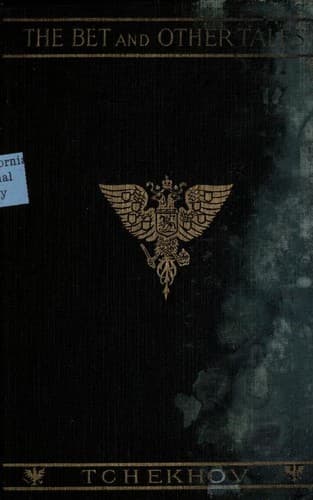
The Bet, and other storiesChekhov, Anton Pavlovich
General
The Bet, and other stories
Chekhov, Anton Pavlovich
Russian fiction -- Translations into English; Short stories, Russian -- Translations into English
This name of mine is very popular. It is known to every literate person
in Russia; abroad it is mentioned from professorial chairs with the
epithets “eminent and esteemed.” It is reckoned among those fortunate
names which to mention in vain or to abuse in public or in the Press
is considered a mark of bad breeding. Indeed, it should be so; because
with my name is inseparably associated the idea of a famous, richly
gifted, and indubitably useful person. I am a steady worker, with
the endurance of a camel, which is important. I am also endowed with
talent, which is still more important. In passing, I would add that
I am a well-educated, modest, and honest fellow. I have never poked
my nose into letters or politics, never sought popularity in disputes
with the ignorant, and made no speeches either at dinners or at my
colleagues’ funerals. Altogether there is not a single spot on my
learned name, and it has nothing to complain of. It is fortunate.
The bearer of this name, that is myself, is a man of sixty-two, with a
bald head, false teeth and an incurable tic. My name is as brilliant
and prepossessing, as I, myself am dull and ugly. My head and hands
tremble from weakness; my neck, like that of one of Turgeniev’s
heroines, resembles the handle of a counter-bass; my chest is hollow
and my back narrow. When I speak or read my mouth twists, and when I
smile my whole face is covered with senile, deathly wrinkles. There is
nothing imposing in my pitiable face, save that when I suffer from the
tic, I have a singular expression which compels anyone who looks at me
to think: “This man will die soon, for sure.”
I can still read pretty well; I can still hold the attention of my
audience for two hours. My passionate manner, the literary form of
my exposition and my humour make the defects of my voice almost
unnoticeable, though it is dry, harsh, and hard like a hypocrite’s.
But I write badly. The part of my brain which governs the ability to
write refused office. My memory has weakened, and my thoughts are
too inconsequent; and when I expound them on paper, I always have a
feeling that I have lost the sense of their organic connection. The
construction is monotonous, and the sentence feeble and timid. I
often do not write what I want to, and when I write the end I cannot
remember the beginning. I often forget common words, and in writing a
letter I always have to waste much energy in order to avoid superfluous
sentences and unnecessary incidental statements; both bear clear
witness of the decay of my intellectual activity. And it is remarkable
that, the simpler the letter, the more tormenting is my effort. When
writing a scientific article I fed much freer and much more intelligent
than in writing a letter of welcome or a report. One thing more: it is
easier for me to write German or English than Russian.
Public-domain text, read in full here on John Shaqi.
Reviews
Reviews
No reviews yet
Be the first to share your thoughts on this work.
Join the Discussion
Join the discussion
Sign in to leave a comment or review.
Sign InorCreate an account