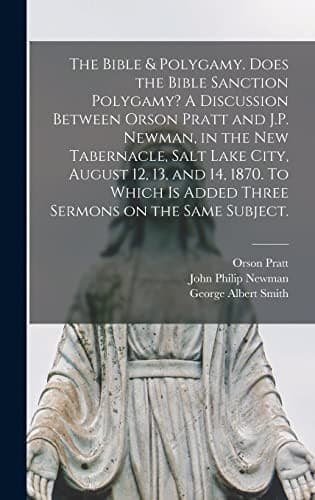
The Bible and Polygamy: Does the Bible Sanction Polygamy? — John Shaqi
The Bible and Polygamy: Does the Bible Sanction Polygamy?Newman, John Philip
Religion
The Bible and Polygamy: Does the Bible Sanction Polygamy?
Newman, John Philip
Bible -- Criticism, interpretation, etc.; Latter Day Saint churches -- Doctrines; Polygamy -- Religious aspects
My friend supposes that the Almighty might have created more women than
one out of Adam's ribs; but Adam had not ribs enough to create fifty
women. My friend speaks against polyandry, or the right of woman to
have more husbands than one. He bases his argument upon the increase
of progeny. Science affirms that where polygamy or polygyny, or a
plurality of wives prevails, there is a tendency to a preponderance or
predominance of one sex over the other, either male or female, which
amounts to an extermination of the race.
I will reply, in due time, to the gentleman's remarks in regard to
Gideon and other Scriptural characters, and especially in regard to
prostitution, or what is known as the social evil. But first, what was
the object of the gentleman yesterday? It was to discover a general
law for the sanction of polygamy. Did he find that law? I deny it.
What is law? Law is the expression of the legislative will; law is
the manner in which an act is performed. It is the law of gravitation
that all things tend to a common centre. It is the law in botany that
the flowers open their fan-like leaves to the light, and close them
beneath the kisses of night. What is the civil law? Simply defining
how the citizens should act. What is the moral law? Simply defining
the conduct of God's moral subjects. Laws are mandatory, prohibitory
and permissive: commanding what should be done; prohibiting what
should not be done, and permitting what may be done. And yet, where
has the gentleman produced this general law which he spent an hour in
searching for yesterday? And then remember, that this law must sanction
polygamy! Perhaps it is not necessary to repeat our definition of the
word "sanction." My learned friend, for whom I have respect, agrees
with me as to the definition of that term, therefore we need not spend
a solitary moment further touching these two points.
There is another vital point in reference to the nature of law. In
legislating upon any subject there must be a great, organic central
principle, mandatory or prohibitory, in reference to that subject; and
all other parts of the particular law as well as of the general code
must be interpreted in harmony therewith.
Public-domain text, read in full here on John Shaqi.
Reviews
Reviews
No reviews yet
Be the first to share your thoughts on this work.
Join the Discussion
Join the discussion
Sign in to leave a comment or review.
Sign InorCreate an account