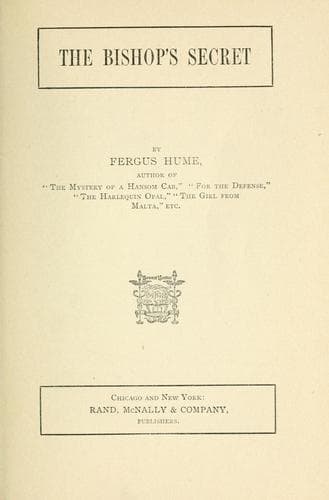
Clergy -- England -- Fiction; Detective and mystery stories
Cargrim would have given much to have overheard this speech, but as the
door and several passages were between him and the talker, he was
ignorant of the incriminating remarks the bishop had let slip. Still
baffled, but still curious, he busied himself with attending to some
business of the See which did not require the personal supervision of Dr
Pendle, and when that prelate took his departure for London by the three
o'clock train, Cargrim attended him to the station, full of meekness and
irritating attentions. It was with a feeling of relief that the bishop
saw his officious chaplain left behind on the platform. He had a secret,
and with the uneasiness of a loaded conscience, fancied that everyone
saw that he had something to conceal--particularly Cargrim. In the
presence of that good young man, this spiritual lord, high-placed and
powerful, felt that he resembled an insect under a microscope, and that
Cargrim had his eye to the instrument. Conscience made a coward of the
bishop, but in the case of his chaplain his uneasy feelings were in some
degree justified.
On leaving the railway station, which was on the outskirts of the modern
town, Cargrim took his way through the brisk population which thronged
the streets, and wondered in what manner he could benefit by the absence
of his superior. As he could not learn the truth from Dr Pendle himself,
he thought that he might discover it from an investigation of the
bishop's desk. For this purpose he returned to the palace forthwith, and
on the plea of business, shut himself up in the library. Dr Pendle was a
careless man, and never locked up any drawers, even those which
contained his private papers. Cargrim, who was too much of a sneak to
feel honourable scruples, went through these carefully, but in spite of
all his predisposition to malignity was unable to find any grounds for
suspecting Dr Pendle to be in any serious trouble. At the end of an hour
he found himself as ignorant as ever, and made only one discovery of any
note, which was that the bishop had taken his cheque-book with him to
London.
To many people this would have seemed a natural circumstance, as most
men with banking accounts take their cheque-books with them when going
on a journey. But Cargrim knew that the bishop usually preferred to
fill his pockets with loose cash when absent for a short time, and this
deviation from his ordinary habits appeared to be suspicious.
'Hum!' thought the chaplain, rubbing his chin, 'I wonder if that
so-called clergyman wanted money. If he had wished for a small sum, the
bishop could easily have given it to him out of the cash-box. Going by
this reasoning, he must have wanted a lot of money, which argues
blackmail. Hum! Has he taken both cheque-books, or only one?'
Public-domain text, read in full here on John Shaqi.
Reviews
Reviews
No reviews yet
Be the first to share your thoughts on this work.
Join the Discussion
Join the discussion
Sign in to leave a comment or review.
Sign InorCreate an account