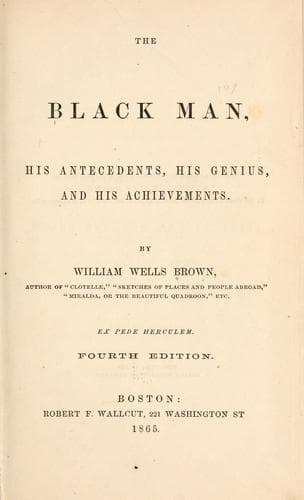
The Black Man: His Antecedents, His Genius, and His AchievementsBrown, William Wells
History
The Black Man: His Antecedents, His Genius, and His Achievements
Brown, William Wells
African Americans -- Biography
We have had a number of our public men to represent us in Europe within
the past twenty-five years; and none have done it more honorably or
with better success to the character and cause of the black man, than
Alexander Crummell. We met him there again and again, and followed in
his track wherever he preached or spoke before public assemblies, and
we know whereof we affirm. In 1852, we believe, he went to Liberia,
where he now resides. At present he and his family are on a visit
to "the States," partly for his health and partly for the purpose
of promoting emigration to Africa. Mr. C. has recently published a
valuable work on Africa, which is highly spoken of by the press;
indeed, it may be regarded as the only finished account of _our mother_
land. Devotedly attached to the interest of the colored man, and having
the moral, social, and intellectual elevation of the natives of Africa
at heart, we do not regret that he considers it his duty to labor in
his _father_ land. Warmly interested in the Republic, and so capable of
filling the highest position that he can be called to, we shall not be
surprised, some day, to hear that Alexander Crummell is president of
Liberia.
ALEXANDRE PETION.
The ambitious and haughty mulattoes had long been dissatisfied with
the obscure condition into which they had been thrown by the reign
of Dessalines, and at the death of that ruler they determined to put
forward their claim. Their great chief, Rigaud, was still in prison in
France, where he had been placed by Napoleon. Christophe had succeeded
to power at the close of the empire, and was at St. Marks when he
heard that Alexandre Petion had been elected president of the Republic
of Hayti, through the instrumentality of the mulattoes. Christophe at
once began to prepare for war. Petion was a quadroon, the successor of
Rigaud and Clervaux to the confidence of the mulattoes. He was a man
of education and refined manners. He had been educated at the Military
School of Paris, and had ever been characterized for his mildness of
temper and the insinuating grace of his address. He was a skilful
engineer, and at the time of his elevation to power he passed for the
most scientific officer and the most erudite individual among the
people of Hayti. Attached to the fortunes of Rigaud, he had acted as
his lieutenant against Toussaint, and had accompanied him to France.
Here he remained until the departure of the expedition under Leclerc,
when he embarked in that disastrous enterprise, to employ his talents
in again restoring his country to the dominion of France. Petion joined
Dessalines, Christophe, and Clervaux, when they revolted and turned
against the French, and aided in gaining the final independence of the
island. Christophe, therefore, as soon as he heard that he had a rival
in Petion, rallied his forces, and started for Port au Prince, to meet
his enemy. The former was already in the field, and the two armies
Public-domain text, read in full here on John Shaqi.
Reviews
Reviews
No reviews yet
Be the first to share your thoughts on this work.
Elsewhere in the archive
Join the Discussion
Join the discussion
Sign in to leave a comment or review.
Sign InorCreate an account