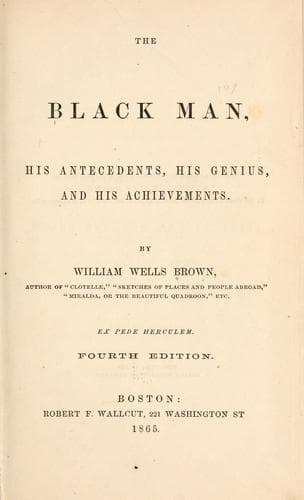
The Black Man: His Antecedents, His Genius, and His AchievementsBrown, William Wells
History
The Black Man: His Antecedents, His Genius, and His Achievements
Brown, William Wells
African Americans -- Biography
met; a battle ensued, and Petion, being defeated, and hotly pursued in
his flight, found it necessary, in order to save his life, to exchange
his uniform with a laborer, and to bury himself up to his neck in a
marsh until his fierce pursuers had disappeared. Petion escaped, and
reached his capital before the arrival of the troops under Christophe.
The latter, after this signal success, pressed forward to Port au
Prince, and laid siege to the town, in hope of an easy triumph over
his rival. But Petion was in his appropriate sphere of action, and
Christophe soon discovered that, in contending with an experienced
engineer in a fortified town, success was of more difficult attainment
than while encountering the same enemy in the open field, where his
science could not be brought into action. Christophe could make no
impression on the town, and feeling ill assured of the steadfastness of
his own proper government at Cape François, he withdrew his forces from
the investment of Port au Prince, resolved to establish in the north
a separate government of his own, and to defer to some more favorable
opportunity the attempt to subdue his rival at Port au Prince. In
September, 1808, Petion commenced another campaign against Christophe,
by sending an army to besiege Port de Paix, which it did; but after a
while it was driven back to Port au Prince by the victorious legions
of the president of the north. Christophe in turn attempted to take
the Mole St. Nicholas from Lamarre, one of Petion's generals, but did
not succeed. The struggle between the two presidents of Hayti had now
continued three years, when a new competitor appeared in the field, by
the arrival of Rigaud from France. This was an unexpected event, which
awakened deep solicitude in the bosom of Petion, who could not avoid
regarding that distinguished general as a more formidable rival than
Christophe. He well knew the attachment of the people to the great
mulatto chief, and he feared his superior talents. The enthusiasm with
which Rigaud was received wherever he appeared, raised the jealousy of
Petion to such a pitch, that he for a time forgot his black rival.
Partisans flew to the standard of Rigaud, and a resort to arms seemed
imminent between him and Petion. A meeting, however, was held by the
two mulatto generals, at the bridge of Miragoane, where a treaty was
signed, by which the south was to be governed by the former, and the
west, and as much as could be wrested from Christophe, by the latter.
But peace between these two was not destined to be of long duration. A
war took place, and Rigaud's troops proved too much for Petion, and he
was defeated with great loss, and his entire army almost annihilated.
But the victorious general did not follow up his successes; and
although he had gained a signal victory, he felt that much of his power
over his followers was passing away. The death of Rigaud once more
gave the field to Christophe and Petion, and they again commenced war
upon each other.
Public-domain text, read in full here on John Shaqi.
Reviews
Reviews
No reviews yet
Be the first to share your thoughts on this work.
Elsewhere in the archive
Join the Discussion
Join the discussion
Sign in to leave a comment or review.
Sign InorCreate an account