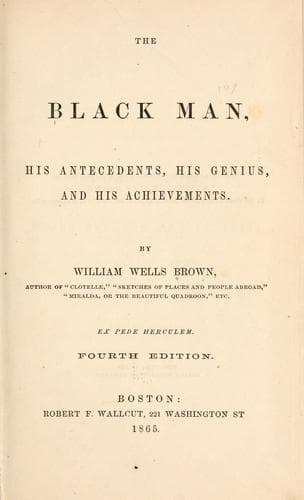
The Black Man: His Antecedents, His Genius, and His AchievementsBrown, William Wells
History
The Black Man: His Antecedents, His Genius, and His Achievements
Brown, William Wells
African Americans -- Biography
The latter was superior to the former in education,
and in the refinement given him by a cultivated understanding and
an extensive intercourse with European society; but he was greatly
inferior to Christophe in boldness and decision of character. Petion
was subtle, cautious, and desponding. He aspired to be the Washington,
as Christophe was deemed the Bonaparte, of Hayti. By insinuating
the doctrines of equality and republicanism, Petion succeeded in
governing, with but ten thousand mulattoes, a population of more than
two hundred thousand blacks. Assuming no pretensions to personal
or official dignity, and totally rejecting all the ceremonial of a
court, it was Petion's ambition to maintain the exterior of a plain
republican magistrate. Clad in the white linen undress of the country,
and with a Madras handkerchief tied about his head, he mixed freely
and promiscuously with his fellow-citizens, or seated himself in the
piazza of the government house, accessible to all. He professed to hold
himself at the disposal of the people, and to be ready at any moment to
submit to their will, whether it was to guide the power of the state,
or yield his head to the executioner.
A republican officer one day called on Petion at the government house,
and while they were alone, the former drew out a pistol and fired at
the president, without injuring him, however; the latter immediately
seized his visitor, disarmed him, and when the guard rushed in, he
found the president and the officer walking the room locked in each
other's arms. This man was ever after the warm friend of Petion. At
the downfall of Napoleon, and the elevation of Louis XVIII., another
effort was made to regain possession of the island by France. But the
latter did not resort to arms. Having no confidence in the French, and
fearing a warlike demonstration, both Petion and Christophe prepared
for defence. Petion had long been despondent for the permanence of the
republic, and this feeling had by degrees grown into a settled despair;
and amidst these perplexities and embarrassments he fell sick, in the
month of March, 1818, and after an illness which continued only eight
days, he died, and was succeeded by General Boyer.
The administration of Petion was mild, and he did all that he could
for the elevation of the people whom he ruled. He was the patron
of education and the arts, and scientific men, for years after his
death, spoke his name with reverence. He was highly respected by the
representatives of foreign powers, and strangers visiting his republic
always mentioned his name in connection with the best cultivated and
most gentlemanly of the people of Hayti. Lightly lie the earth on the
bones of Petion, and let every cloud pass away from his memory.
MARTIN R. DELANY, M. D.
Public-domain text, read in full here on John Shaqi.
Reviews
Reviews
No reviews yet
Be the first to share your thoughts on this work.
Elsewhere in the archive
Join the Discussion
Join the discussion
Sign in to leave a comment or review.
Sign InorCreate an account