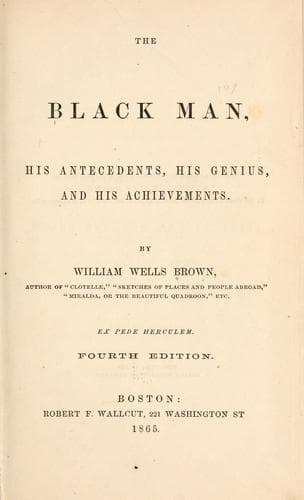
The Black Man: His Antecedents, His Genius, and His AchievementsBrown, William Wells
History
The Black Man: His Antecedents, His Genius, and His Achievements
Brown, William Wells
African Americans -- Biography
She was the armed despatch and transportation steamer attached to
the engineer department at Charleston, under Brigadier General
Ripley, whose bark, a short time since, was brought to the
blockading fleet by several contrabands. The bringing out of this
steamer, under all the circumstances, would have done credit to
any one. At four in the morning, in the absence of the captain,
who was on shore, she left her wharf close to the government
office and headquarters, with the Palmetto and "Confederate" flags
flying, and passed the successive forts, saluting, as usual,
by blowing the steam whistle. After getting beyond the range
of the last gun, they hauled down the rebel flags, and hoisted
a white one. The Onward was the inside ship of the blockading
squadron in the main channel, and was preparing to fire when her
commander made out the white flag. The armament of the steamer
is a 32-pounder, or pivot, and a fine 24-pound howitzer. She has
besides, on her deck, four other guns, one seven inch rifled,
which were to be taken, on the morning of the escape, to the
new fort on the middle ground. One of the four belonged to Fort
Sumter, and had been struck, in the rebel attack, on the muzzle.
Robert Small, the intelligent slave, and pilot of the boat, who
performed this bold feat so skilfully, informed me of this
fact, presuming it would be a matter of interest to us to have
possession of this gun. This man, Robert Small, is superior to any
who have come into our lines, intelligent as many of them have
been. His information has been most interesting, and portions
of it of the utmost importance. The steamer is quite a valuable
acquisition to the squadron by her good machinery and very light
draught. The officer in charge brought her through St. Helena
Sound, and by the inland passage down Beaufort River, arriving
here at ten last night. On board the steamer, when she left
Charleston, were eight men, five women, and three children. I
shall continue to employ Small as pilot on board the Planter, for
inland waters, with which he appears to be very familiar.
I do not know whether, in the view of the government, the vessel
will be considered a prize; but if so, I respectfully submit to
the Department the claims of the man Small and his associates.
Very respectfully, your obedient servant,
S. F. DUPONT,
_Flag Officer, Commanding, &c._
A bill was at once introduced in Congress to consider the Planter a
prize, and to award the prize-money to her crew. The _New York Tribune_
had the following editorial on the subject:--
Public-domain text, read in full here on John Shaqi.
Reviews
Reviews
No reviews yet
Be the first to share your thoughts on this work.
Elsewhere in the archive
Join the Discussion
Join the discussion
Sign in to leave a comment or review.
Sign InorCreate an account