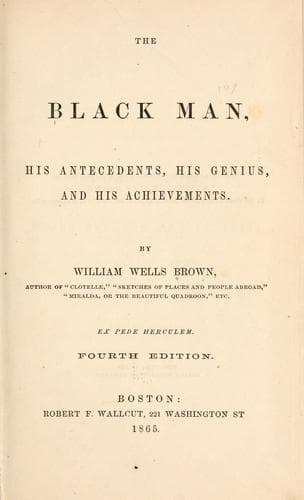
The Black Man: His Antecedents, His Genius, and His AchievementsBrown, William Wells
History
The Black Man: His Antecedents, His Genius, and His Achievements
Brown, William Wells
African Americans -- Biography
"The House of Representatives at Washington, it is to be hoped,
will be more just to their own sense of right, and to their more
generous impulses, than to put aside again the Senate bill giving the
prize-money they have so well earned to the pilot and crew of the
steamer Planter. Neither House would have done an act unworthy of their
dignity had they promptly passed a vote of thanks to Robert Small and
his fellows for the cool courage with which they planned and executed
their escape from rebel bondage, and the unswerving loyalty which
prompted them, at the same time, to bring away such spoils from the
enemy as would make a welcome addition to the blockading squadron.
"If we must still remember with humiliation that the Confederate flag
yet waves where our national colors were first struck, we should be all
the more prompt to recognize the merit that has put into our possession
the first trophy from Fort Sumter. And the country should feel doubly
humbled if there is not magnanimity enough to acknowledge a gallant
action, because it was the head of a black man that conceived, and
the hand of a black man that executed it. It would better, indeed,
become us to remember that no small share of the naval glory of the war
belongs to the race which we have forbidden to fight for us; that one
negro has recaptured a vessel from a southern privateer, and another
has brought away from under the very guns of the enemy, where no fleet
of ours has yet dared to venture, a prize whose possession a commodore
thinks worthy to be announced in a special despatch."
The bill was taken up and passed, and the brave Small and his
companions received justice at the hands of the government.
FREDERICK DOUGLASS.
The career of the distinguished individual whose name heads this
page is more widely known than that of any other living colored man,
except, perhaps, Alexandre Dumas. The narrative of his life, published
in 1845, gave a new impetus to the black man's literature. All other
stories of fugitive slaves faded away before the beautifully written,
highly descriptive, and thrilling memoir of Frederick Douglass. Other
narratives had only brought before the public a few heart-rending
scenes connected with the person described. But Mr. Douglass, in his
book, brought not only his old master's farm and its occupants before
the reader, but the entire country around him, including Baltimore
and its ship yard. The manner in which he obtained his education,
and especially his learning to write, has been read and re-read by
thousands in both hemispheres. His escape from slavery is too well
understood to need a recapitulation here. He took up his residence in
New Bedford, where he still continued the assiduous student--mastering
the different branches of education which the accursed institution had
deprived him of in early life.
Public-domain text, read in full here on John Shaqi.
Reviews
Reviews
No reviews yet
Be the first to share your thoughts on this work.
Elsewhere in the archive
Join the Discussion
Join the discussion
Sign in to leave a comment or review.
Sign InorCreate an account