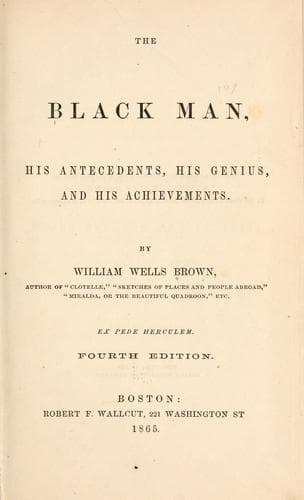
The Black Man: His Antecedents, His Genius, and His AchievementsBrown, William Wells
History
The Black Man: His Antecedents, His Genius, and His Achievements
Brown, William Wells
African Americans -- Biography
A poem signifies design, method, harmony, and therefore consistency of
parts. A man may be gifted with the most vividly ideal nature; he may
shoot from his brain some blazing poetic thought or imagery, which may
arouse wonder and admiration, as a comet does; and yet he may have no
constructiveness, without which the materials of poetry are only so
many glittering fractions. A poem can never be tested by its length or
brevity, but by the adaptation of its parts. A complete poem is the
architecture of thought and language. It requires artistic skill to
chisel rough blocks of marble into as many individual forms of beauty;
but not only skill, but genius, is needed to arrange and harmonize
those forms into the completeness of a Parthenon. A grave popular
error, and one destructive of personal usefulness, and obstructive to
literary progress, is the free-and-easy belief that because a man has
the faculty of investing common things with uncommon ideas, therefore
he can write a poem.
The idea of poetry is to give pleasurable emotions, and the world
listens to a poet's voice as it listens to the singing of a summer
bird; that which is the most suggestive of freedom and eloquence being
the most admired. Professor Reason has both the genius and the artistic
skill. We regret that we are able to give only the last two verses of
"Hope and Confidence."
"There's nothing so lovely and bright below,
As the shapes of the purified mind;
Nought surer to which the weak heart can grow,
On which it can rest as it onward doth go,
Than that Truth which its own tendrils bind.
"Yes, Truth opes within a pure sun-tide of bliss,
And shows in its ever calm flood
A transcript of regions where no darkness is,
Where Hope its conceptions may realize,
And Confidence sleep in the good."
CHARLOTTE L. FORTEN.
In the autumn of 1854, a young colored lady of seventeen summers,
unable to obtain admission into the schools of her native city
(Philadelphia) on account of her complexion, removed to Salem,
Massachusetts, where she at once entered the Higginson Grammar School.
Here she soon secured the respect and esteem of the teachers and her
fellow-pupils. Near the end of the last term, the principal of the
establishment invited the scholars to write a poem each, to be sung
at the last day's examination, and at the same time expressing the
desire that the authors should conceal their names. As might have been
expected, this drew out all the poetical genius of the young aspirants.
Fifty or more manuscripts were sent in, and one selected, printed on a
neat sheet, and circulated through the vast audience who were present.
The following is the piece:--
A PARTING HYMN.
When Winter's royal robes of white
From hill and vale are gone,
And the glad voices of the spring
Upon the air are borne,
Friends, who have met with us before,
Within these walls shall meet no more.
Public-domain text, read in full here on John Shaqi.
Reviews
Reviews
No reviews yet
Be the first to share your thoughts on this work.
Elsewhere in the archive
Join the Discussion
Join the discussion
Sign in to leave a comment or review.
Sign InorCreate an account