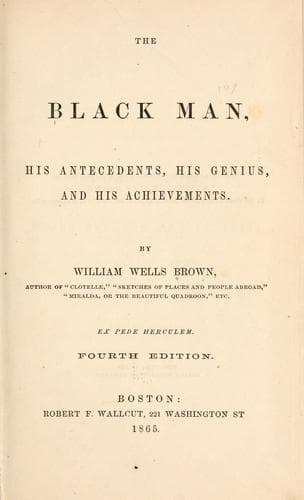
The Black Man: His Antecedents, His Genius, and His AchievementsBrown, William Wells
History
The Black Man: His Antecedents, His Genius, and His Achievements
Brown, William Wells
African Americans -- Biography
Most of the army have been disbanded; and those retained are better
fed, better paid, and clothed in a more suitable manner. New firearms
have been introduced, reforms instituted both in the government and the
army, agriculture and commerce encouraged, old roads repaired and new
ones built. His state papers show him to be a man of superior natural
abilities, and we believe that he is destined to do more for Hayti and
her people than any ruler since the days of Toussaint L'Ouverture.
Geffrard is a grief in color (nearly black), of middle height,
slim in figure, a pleasing countenance, sparkling eye, gray hair,
fifty-six years of age, limbs supple by bodily exercise, a splendid
horseman, and liberal to the arts, even to extravagance. Possessing a
polished education, he is gentlemanly in his conversation and manners.
His democratic ideas induce him to dress without ornaments of any
kind. Soon after assuming the presidency, he resolved to encourage
immigration, and issued an address to the colored Americans, filled
with patriotic and sympathetic feeling for his race.
GEORGE B. VASHON.
Passing through the schools of Pittsburg, his native place, and
graduating at Oberlin College with the degree of Master of Arts, George
B. Vashon started in life with the advantage of a good education. He
studied law with Hon. Walter Forward, and was admitted to the bar in
1847. He soon after visited Hayti, where he remained nearly three
years, returning home in 1850. Called to a professorship in New York
Central College, Mr. Vashon discharged the duties of the office with
signal ability. A gentleman--a graduate of that institution, now a
captain in the federal army--told the writer that he and several of his
companions, who had to recite to Professor Vashon, made it a practice
for some length of time to search Greek, Latin, and Hebrew, for phrases
and historical incidents, and would then question the professor, with
the hope of "running him on a snag." "But," said he, "we never caught
him once, and we came to the conclusion that he was the best-read
man in the college." Literature has a history, and few histories can
compare with it in importance, significance, and moral grandeur. There
is, therefore, a great price to pay for literary attainments, which
will have an inspiring and liberalizing influence--a price not in
silver and gold, but in thorough mental training. This training will
give breadth of view, develop strength of character and a comprehensive
spirit, by which the ever-living expressions of truth and principle in
the past may be connected with those of a like character in the present.
Public-domain text, read in full here on John Shaqi.
Reviews
Reviews
No reviews yet
Be the first to share your thoughts on this work.
Elsewhere in the archive
Join the Discussion
Join the discussion
Sign in to leave a comment or review.
Sign InorCreate an account