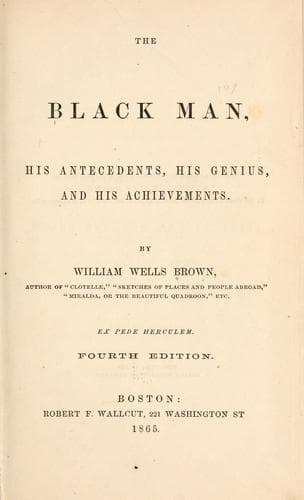
The Black Man: His Antecedents, His Genius, and His AchievementsBrown, William Wells
History
The Black Man: His Antecedents, His Genius, and His Achievements
Brown, William Wells
African Americans -- Biography
Mr. Vashon seems to have taken this view of what constitutes the
thorough scholar, and has put his theory into practice. All of the
productions of his pen show the student and man of literature. But
he is not indebted alone to culture, for he possesses genius of no
mean order--poetic genius, far superior to many who have written and
published volumes. As Dryden said of Shakspeare, "he needed not the
spectacles of books to read Nature; he looked inward, and found her
there." The same excellence appertains to his poetical description of
the beautiful scenery and climate of Hayti, in his "Vincent Ogé." His
allusion to Columbus's first visit to the island is full of solemn
grandeur:--
"The waves dash brightly on thy shore,
Fair island of the southern seas,
As bright in joy as when, of yore,
They gladly hailed the Genoese--
That daring soul who gave to Spain
A world-last trophy of her reign."
Our limited space will not permit our giving more of this, or other
poems of Mr. Vashon. The following extract from his admirable essay in
the _Anglo-African Magazine_, entitled, "The Successive Advances of
Astronomy," is characteristic of his prose:--
"The next important step recorded in the annals of astronomy was the
effort to reform the calendar by means of the bissextile year. This
effort was made at the time when Julius Cæsar was chief pontiff at
Rome. It is noteworthy, as being the only valuable contribution made
to astronomical science by the Romans; and, even in this matter, Cæsar
acted under the guidance of the Grecian astronomer Sosigenes. We are
not to suppose, however, that the Romans were totally indifferent to
the subject of astronomy. We are informed by Cicero, in his elegant
treatise concerning 'Old Age,' that Caius Gallus was accustomed to
spend whole days and nights in making observations upon the heavenly
bodies, and that he took pleasure in predicting to his friends the
eclipses of the sun and moon a long time before they occurred. Besides,
in the 'Scipio's Dream' of the same author, we find, in the course of
an admirable dissertation upon the immortality of the soul, an account
of a terrestrial system, according to which our earth was the central
body, around which the concave sphere of the starry heavens revolved;
while, in the space between, the Moon, Venus, Mercury, the Sun, Mars,
Jupiter, and Saturn moved with retrograde courses, in the order here
mentioned. In fact, this system was the one which was afterwards
adopted, elaborated, and zealously maintained by the famous Ptolemy
of Alexandria, and which has ever since borne his name. To Ptolemy,
then, who flourished about the commencement of the second century,
the world is indebted for the first complete system of astronomy that
secured the approbation of all the learned. This it was enabled to do
by the ingenious, although not perfect, explanation which it gave of
the planetary movements, by supposing these bodies to move in circles
Public-domain text, read in full here on John Shaqi.
Reviews
Reviews
No reviews yet
Be the first to share your thoughts on this work.
Elsewhere in the archive
Join the Discussion
Join the discussion
Sign in to leave a comment or review.
Sign InorCreate an account