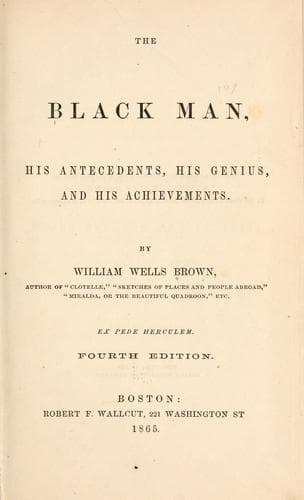
The Black Man: His Antecedents, His Genius, and His AchievementsBrown, William Wells
History
The Black Man: His Antecedents, His Genius, and His Achievements
Brown, William Wells
African Americans -- Biography
Shortly after this, Mr. Martin was ordained and settled over the
Michigan Street Baptist Church, Buffalo, New York, where he labored
with signal success till April, 1859, when he removed east. During the
same summer he was introduced to the Boston public by Mr. Kalloch, the
popular preacher at the Tremont Temple. The latter, pleased with Mr.
Martin, secured his services while away on his annual vacation, which
occupied six or eight weeks. No place of religious worship was more
thronged than the Temple during the time that he filled its pulpit.
At the termination of his engagement at the Temple, Mr. Martin was
invited by Dr. Eddy to preach for him a few weeks, which he did with
credit to himself and satisfaction to the society. The first Baptist
Church at Lawrence being without a pastor, Mr. Martin was engaged to
supply the pulpit, and was there seven or eight months, and might have
remained longer; but during this time he received a call from the Joy
Street Church, Boston, and feeling that his labor was more needed
with his own color, he accepted the latter. He has now been at the
Joy Street Church about three years, where his preaching has met with
marked success. That society had long been in a declining state; but
the church is now as well filled on Sundays as any place in the city.
In the summer of 1861, Mr. Martin visited England, and remained abroad
six months, where he did good service for the cause of freedom. On his
return home he was warmly welcomed by his church and congregation. Soon
after, he secured the freedom of his only sister and her two children,
whom he settled at the west. In person, Mr. Martin is somewhat taller
than the medium height; firm, dignified walk; not what would be termed
handsome, but has a pleasing countenance; in race, half and half;
eyes clear and bright; forehead well developed; gentlemanly in his
deportment; has a popularity not surpassed by any of the preachers of
Boston.
He has written considerably for the press, both prose and poetry. Some
of the latter is much admired. His poem "The Hero and the Slave" has
been read in public entertainments, and received with applause.
CHARLES LENOX REMOND.
Charles L. Remond is a native of Salem, Mass. He has the honor,
we believe, of being the first colored man to take the field as a
lecturer against slavery. He has been, more or less, in the employ of
the Anti-Slavery Society for the past twenty-eight or thirty years.
In 1840, he visited England as a delegate to the first "World's
Anti-Slavery Convention," held in London. He remained abroad nearly two
years, lecturing in the various towns and cities of Great Britain and
Ireland. The following lines, addressed to him, appeared in one of the
public journals, after the delivery of one of his thrilling speeches,
in Belfast, and will give some idea of the estimation in which he was
held as a platform speaker.
TO C. L. REMOND.
Public-domain text, read in full here on John Shaqi.
Reviews
Reviews
No reviews yet
Be the first to share your thoughts on this work.
Elsewhere in the archive
Join the Discussion
Join the discussion
Sign in to leave a comment or review.
Sign InorCreate an account