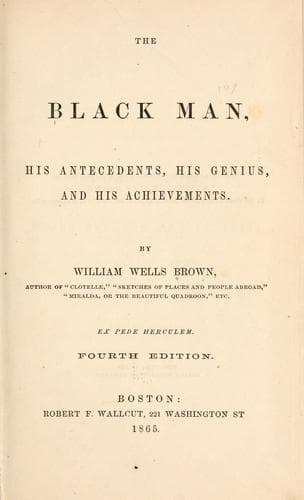
The Black Man: His Antecedents, His Genius, and His AchievementsBrown, William Wells
History
The Black Man: His Antecedents, His Genius, and His Achievements
Brown, William Wells
African Americans -- Biography
Go forth and fear not! Glorious is the cause
Which thou dost advocate; and nobly, too,
Hast thou fulfilled thy mission--nobly raised
Thy voice against oppression, and the woes
Of injured millions; and, if they are men,
Who can deny for them a Saviour died?
Nor will it e'er be asked, in that dread day
When black and white shall stand before the throne
Of Him their common Parent, "Unto which
Partition of the human race didst thou
Belong on earth?" Enough for thee to fill
The lot assigned thee, as ordained by Heaven.
I would not praise thee, Remond,--thou hast gifts
Bestowed upon thee for a noble end;
And for the use of which account must be
Returned to Him who lent them. May this thought
Preserve thee in his fear, and may the praise
Be given only to his mighty name.
And if, returning to thy native land,
By thee beloved, though dark with crimes that stain
Her boasted freedom, thou art called to prove
Thy true allegiance, even then go forth
Resigned to suffer,--trust thy all to Him
Who can support thee, whilst a still, small voice,
Within thy breast, shall whisper, "All is well."
Mr. Remond was welcomed on his return home, and again resumed his
vocation as a lecturer. In stature he is small, spare made, neat, wiry
build, and genteel in his personal appearance. He has a good voice, and
is considered one of the best declaimers in New England. Faultless in
his dress, and an excellent horseman, Mr. Remond has long been regarded
the Count D'Orsay of the anti-slavery movement. He has written little
or nothing for the press, and his notoriety is confined solely to
the platform. Sensitive to a fault, and feeling sorely the prejudice
against color which exists throughout the United States, his addresses
have been mainly on that subject, on which he is always interesting. He
is a good writer who embodies in his works the soul and spirit of the
times in which he lives,--provided they are worth embodying,--and the
common sympathy of the great mass is sounder criticism by far than the
rules of mere scholars, who, buried up in their formulas, cannot speak
so as to arrest the attention or move the heart. Adaptation without
degeneracy is the great law to be followed. What is true of the writer
is also true of the speaker. No man can put more real meaning in fewer
words than Mr. Remond, and no one can give them greater force. The
following extract from a speech of Mr. Remond, delivered before the New
England Anti-Slavery Convention, at its anniversary in May, 1859, is
characteristic of his style.
Public-domain text, read in full here on John Shaqi.
Reviews
Reviews
No reviews yet
Be the first to share your thoughts on this work.
Elsewhere in the archive
Join the Discussion
Join the discussion
Sign in to leave a comment or review.
Sign InorCreate an account