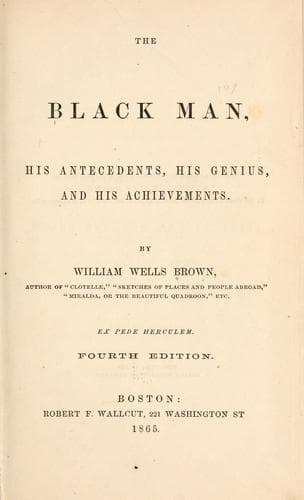
The Black Man: His Antecedents, His Genius, and His AchievementsBrown, William Wells
History
The Black Man: His Antecedents, His Genius, and His Achievements
Brown, William Wells
African Americans -- Biography
"The great consideration that presses upon me is, what may we do
to make ourselves of more importance in community--necessary,
indispensable? To sustain such a relation as this to community, (and
it is possible,) is to secure, beyond a question, all the respect,
to make sure the enjoyment of all the rights, that the most deferred
to of the land enjoy. Society is deferential; it defers to power.
Learning, and wealth, and power are most potent in society. It is not
necessary that many men and women of us be wealthy and learned before
we can force respect as a class; but it is necessary that we exhibit a
proportionate representative character for learning and wealth, to be
respected. It is not numbers alone, it is not universal wealth, it is
not general learning, that secures to those, known by a distinction in
society as whites--that gains them power; for they are not generally
wealthy, not commonly learned. The number of these among them, as in
all communities, is limited; but that number forms a representative
character, some of whom excel; hence they have power--the class enjoy a
name.
"There is another sense of power in community, which, though silent,
has its weight--it should be most potent: that power is moral
character. This also, like the other powers of which I have spoken,
need not be universal to have an effect favorable to a class. I think
that I am not claiming too much for the colored people in asserting
that we have a decent representation in this respect--a most remarkable
one, considering all the depressing influences which the present and
preceding generations have had to struggle up under. Happily, this
power on community is not growing less; it is on the increase. An
illustration of the correctness of my position as to the power of a
representative character for wealth and learning in commanding respect,
is forcibly exhibited in the Celts in our midst, who came among us poor
and ignorant, and who, consequently, fill menial, dependent positions.
They are the least respected of all immigrants. In speaking thus, I am
simply dealing with facts, not intending to be invidious. The German
element, mingling with the general element which comes among us,
representing a higher intelligence, more wealth, with great practical
industry, is silently stealing a hold, a power in the nation, because
of these possessions, at which native America will yet start. Now,
gentlemen, if these be facts, is it not well for us, as sensible men
here assembled, to consider our best interest--to have in view these
sources of power? Would it not be well to consider these--to fall
upon some plan by which we may possess or excite to the possession of
them--rather than devote much of our time in a discussion as to the
injustice of our fellow-countrymen in their relation to us? Of this
_they_ know full well, and _we_ too bitterly.
Public-domain text, read in full here on John Shaqi.
Reviews
Reviews
No reviews yet
Be the first to share your thoughts on this work.
Elsewhere in the archive
Join the Discussion
Join the discussion
Sign in to leave a comment or review.
Sign InorCreate an account