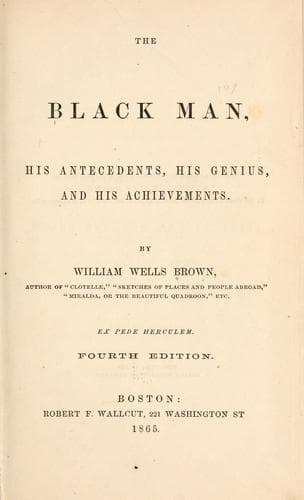
The Black Man: His Antecedents, His Genius, and His AchievementsBrown, William Wells
History
The Black Man: His Antecedents, His Genius, and His Achievements
Brown, William Wells
African Americans -- Biography
"The ballot is a power in this country which should not be lost sight
of by us. Were it more generally exercised by the colored people,
the effect would be very perceptible. Those of them residents of the
states that deny them the privilege of the elective franchise, should
earnestly strive to have the right and the power secured to them;
those who have it should never let an occasion pass, when they may
consistently exercise it, without doing so. We know that the government
and the states have acted most unfairly in their relation to us; but
that government and the states, in doing so, have clearly disregarded
justice, as well as perverted the legal interpretation of the supreme
law of the land, as set forth in its constitution; which facts alone
require that we exercise the right to vote, whenever we can, towards
correcting this injustice. Were it known on election day that any
colored man would deposit a vote, that there would be a concert of
action in doing so, the effect would be irresistible. Cannot such
a vote be cast at the approaching presidential election? Will the
Republican party (a party which is entitled to credit for the service
it has rendered to the cause of freedom) put in nomination, in 1860, a
man for whom we can, with some degree of consistency, cast our ballots?
It has such men in its ranks--prominent men of the party--men who are
available.
"I would have it noted, that we cannot vote for a man who subscribes to
the doctrine that, in struggling for freedom in a presidential or any
other election, he ignores the rights of the colored man.
"There is an increased as well as an increasing respect for us in
community. This is not simply because we have friends (all praise to
them) who speak out boldly and uncompromisingly for the right,--in
fact, the most of their efforts have been directed towards relieving
the country of the blight and of the injustice of slavery,--but it is
because our character, as a class, is better understood."
Mr. Downing is a native of New York, but spends his summers at Newport,
where he has an excellent retreat for those seeking that fashionable
watering-place, and where he stands high with the better class of the
community.
ROBERT PURVIS.
Few private gentlemen are better known than Robert Purvis. Born in
Charleston, S. C., a son of the late venerable William Purvis, Esq.,
educated in New England, and early associated with William Lloyd
Garrison, Francis Jackson, and Wendell Phillips, he has always
been understood as belonging to the most ultra wing of the radical
abolitionists. Residing in Philadelphia when it was unsafe to avow
one's self a friend of the slave, Mr. Purvis never was known to deny
his hatred to the "peculiar institution." A writer for one of the
public journals, seeking out distinguished colored persons as subjects
for his pen, paid him a visit, of which the following is his account:--
Public-domain text, read in full here on John Shaqi.
Reviews
Reviews
No reviews yet
Be the first to share your thoughts on this work.
Elsewhere in the archive
Join the Discussion
Join the discussion
Sign in to leave a comment or review.
Sign InorCreate an account