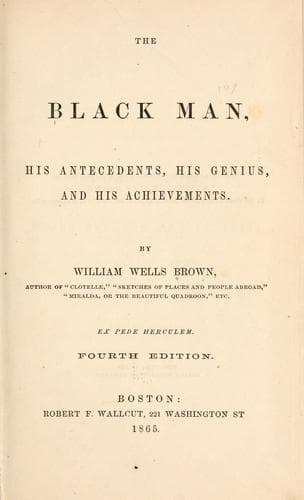
The Black Man: His Antecedents, His Genius, and His AchievementsBrown, William Wells
History
The Black Man: His Antecedents, His Genius, and His Achievements
Brown, William Wells
African Americans -- Biography
"He is the heaviest tax-payer in the township, and owns two very
valuable farms. By his influence the public schools of the township
have been thrown open to colored children. He has also built, at his
own expense, a hall for free debate. We left him with feelings of
higher regard than we have yet felt for any of his people. It is proper
to remark, that Purvis is the grandchild of a blackamoor, who was taken
a slave to South Carolina."
Although disdaining all profession of a public character, Mr. Purvis
is, nevertheless, often invited to address public gatherings. As a
speaker he is energetic, eloquent, and sarcastic. He spares neither
friend nor foe in his argument; uses choice language, and appears to
feel that nature and humanity are the everlasting proprietors of truth,
and that truth should be spoken at all times. Mr. Purvis is an able
writer, and whatever he says comes directly from the heart. His letter
to Hon. S. C. Pomeroy, on colonization, is characteristic of him. We
regret that space will not allow us to give the whole of this timely
and manly production.
"There are some aspects of this project which surely its advocates
cannot have duly considered. You purpose to exile hundreds and
thousands of your laborers. The wealth of a country consists mainly
in its labor. With what law of economy, political or social, can you
reconcile this project to banish from your shores the men that plough
your fields, drive your teams, and help build your houses? Already the
farmers around me begin to feel the pinching want of labor; how will
it be after this enormous draft? I confess the project seems to me one
of insanity. What will foreign nations, on whose good or ill will so
much is supposed now to depend, think of this project? These nations
have none of this vulgar prejudice against complexion. What, then,
will they think of the wisdom of a people who, to gratify a low-born
prejudice, deliberately plan to drive out hundreds and thousands of the
most peaceful, industrious, and competent laborers? Mr. Roebuck said
in a late speech at Sheffield, as an argument for intervention, 'that
the feeling against the black was stronger at the north than in the
south.' Mr. Roebuck can now repeat that assertion, and point to this
governmental project in corroboration of its truth. A 'Slaveholders'
Convention' was held a few years since in Maryland to consider whether
it would not be best either to re-enslave the free blacks of that
state, or banish them from its borders. The question was discussed, and
a committee, the chairman of which was United States Senator Pearce,
was appointed to report upon it. That committee reported 'that to
enslave men now free would be inhuman, and to banish them from the
state would be to inflict a deadly blow upon the material interests of
the commonwealth; that their labor was indispensable to the welfare
of the state.' Sir, your government proposes to do that which the
Public-domain text, read in full here on John Shaqi.
Reviews
Reviews
No reviews yet
Be the first to share your thoughts on this work.
Elsewhere in the archive
Join the Discussion
Join the discussion
Sign in to leave a comment or review.
Sign InorCreate an account