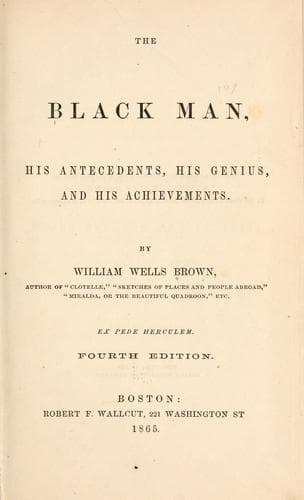
The Black Man: His Antecedents, His Genius, and His AchievementsBrown, William Wells
History
The Black Man: His Antecedents, His Genius, and His Achievements
Brown, William Wells
African Americans -- Biography
The doctor has been a good student, is a ripe scholar, and is deeply
versed in theology. While at Paris, in 1849, we, with the American
and English delegates to the Peace Congress, attended divine service
at the Protestant Church, where Dr. Pennington had been invited to
preach. His sermon on that occasion was an eloquent production, made a
marked impression on his hearers, and created upon the minds of all a
more elevated idea of the abilities of the negro. In past years he has
labored zealously and successfully for the education and moral, social,
and religious elevation of his race. The doctor is unadulterated in
blood, with strongly-marked African features; in stature he is of the
common size, slightly inclined to corpulency, with an athletic frame
and a good constitution. The fact that Dr. Pennington is considered
a good Greek, Latin, and German scholar, although his early life was
spent in slavery, is not more strange than that Henry Diaz, the black
commander in Brazil, is extolled in all the histories of that country
as one of the most sagacious and talented men and experienced officers
of whom they could boast; nor that Hannibal, an African, gained by his
own exertion a good education, and rose to be a lieutenant-general and
director of artillery under Peter the Great; nor that Don Juan Latino,
a negro, became teacher of the Latin language at Seville; nor that
Anthony William Amo, a native of Guinea, took the degree of Doctor of
Philosophy at the University of Wittenburg; nor that James J. Capetein,
fresh from the coast of Africa, became master of the Latin, Greek,
Hebrew, and Chaldaic languages; nor that James Derham, an imported
negro, should, by his own genius and energy, be considered one of the
ablest physicians in New Orleans, and of whom Dr. Rush says, "I found
him very learned. I thought I could give him information concerning
the treatment of diseases; but I learned more from him than he could
expect from me." We might easily extend the catalogue, for we have
abundant materials. Blumenbach boldly affirms of the negro, "There is
no savage people who have distinguished themselves by such examples of
perfectibility and capacity for scientific cultivation."
A MAN WITHOUT A NAME.
Public-domain text, read in full here on John Shaqi.
Reviews
Reviews
No reviews yet
Be the first to share your thoughts on this work.
Elsewhere in the archive
Join the Discussion
Join the discussion
Sign in to leave a comment or review.
Sign InorCreate an account