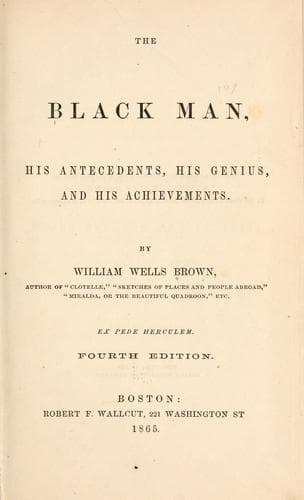
The Black Man: His Antecedents, His Genius, and His AchievementsBrown, William Wells
History
The Black Man: His Antecedents, His Genius, and His Achievements
Brown, William Wells
African Americans -- Biography
It was in the month of December, 1852, while Colonel Rice and family
were seated around a bright wood fire, whose blaze lighted up the large
dining room in their old mansion, situated ten miles from Dayton, in
the State of Ohio, that they heard a knock at the door, which was
answered by the familiar "Come in" that always greets the stranger in
the Western States. Squire Loomis walked in and took a seat on one
of the three rocking-chairs, which had been made vacant by the young
folks, who rose to give place to their highly influential and wealthy
neighbor. It was a beautiful night; the sky was clear, the wind had
hushed its deep moanings, the most brilliant of the starry throng stood
out in bold relief, despite the superior light of the moon. "I see
some one standing at the gate," said Mrs. Rice, as she left the window
and came nearer the fire. "I'll go out and see who it is," exclaimed
George, as he quitted his chair and started for the door. The latter
soon returned and whispered to his father, and both left the room,
evincing that something unusual was at hand. Not many minutes elapsed,
however, before the father and son entered, accompanied by a young
man, whose complexion showed plainly that other than Anglo-Saxon blood
coursed through his veins. The whole company rose, and the stranger
was invited to draw near to the fire. Question after question was now
pressed upon the new-comer by the colonel and the squire, but without
eliciting satisfactory replies.
"You need not be afraid, my friend," said the host, as he looked
intently in the colored man's face, "to tell where you are from and to
what place you are going. If you are a fugitive, as I suspect, give us
your story, and we will protect and defend you to the last."
Taking courage from these kind remarks, the mulatto said, "I was born,
sir, in the State of Kentucky, and raised in Missouri. My master
was my father; my mother was his slave. That, sir, accounts for the
fairness of my complexion. As soon as I was old enough to labor I was
taken into my master's dwelling as a servant, to attend upon the
family. My mistress, aware of my near relationship to her husband,
felt humiliated, and often in her anger would punish me severely for
no cause whatever. My near approach to the Anglo-Saxon aroused the
jealousy and hatred of the overseer, and he flogged me, as he said, to
make me know my place. My fellow-slaves hated me because I was whiter
than themselves. Thus my complexion was construed into a crime, and
I was made to curse my father for the Anglo-Saxon blood that courses
through my veins.
Public-domain text, read in full here on John Shaqi.
Reviews
Reviews
No reviews yet
Be the first to share your thoughts on this work.
Elsewhere in the archive
Join the Discussion
Join the discussion
Sign in to leave a comment or review.
Sign InorCreate an account