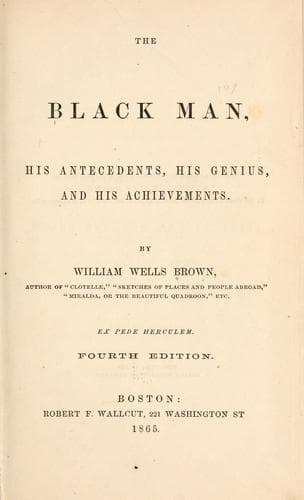
The Black Man: His Antecedents, His Genius, and His AchievementsBrown, William Wells
History
The Black Man: His Antecedents, His Genius, and His Achievements
Brown, William Wells
African Americans -- Biography
"I have no name," said the fugitive. "I once had a name,--it was
William,--but my master's nephew came to live with him, and as I was a
house servant, and the young master and I would, at times, get confused
in the same name, orders were given for me to change mine. From that
moment, I resolved that, as slavery had robbed me of my liberty and my
name, I would not attempt to have another till I was free. So, sir, for
once you have a man standing before you without a name."
SAMUEL R. WARD.
Few public speakers exercised greater influence in the pulpit and on
the platform, in behalf of human freedom, than did Samuel R. Ward, in
the early days of abolition agitation. From 1840 up to the passage
of the Fugitive Slave Law, in 1850, he either preached or lectured
in every church, hall, or school house in Western and Central New
York. Endowed with superior mental powers, and having, through the
aid of Hon. Gerrit Smith, obtained a good education, and being a
close student, Mr. Ward's intellectual faculties are well developed.
He was, for several years, settled over a white congregation, of the
Presbyterian order, at South Butler, N. Y., where he preached with
great acceptance, and was highly respected. As a speaker, he was
justly held up as one of the ablest men, white or black, in the United
States. The first time we ever heard him, (in 1842,) he was announced
in the advertisement as "the black Daniel Webster." Standing above
six feet in height, possessing a strong voice, and energetic in his
gestures, Mr. Ward always impressed his highly finished and logical
speeches upon his hearers. No detractor of the negro's abilities ever
attributed his talents to his having Anglo-Saxon blood in his veins. As
a black man, Mr. Ward was never ashamed of his complexion, but rather
appeared to feel proud of it. When Captain Rynders and his followers
took possession of the platform of the American Anti-Slavery Society,
at their anniversary, in New York, in the spring of 1852, Frederick
Douglass rose to defend the rights of the Association and the liberty
of speech. Rynders objected to the speaker upon the ground that he was
not a negro, but half white. Ward, being present, came forward, amid
great applause, and the rowdy leader had to "knock under," and confess
that genuine eloquence was not confined to the white man. William J.
Wilson says of Ward, "Ideas form the basis of all Mr. Ward utters. If
words and ideas are not inseparable, then, as mortar is to the stones
that compose the building, so are his words to his ideas. In this, I
judge, lies Mr. Ward's greatest strength. Concise without abruptness;
without extraordinary stress, always clear and forcible; if sparing of
ornament, never inelegant,--in all, there appears a consciousness of
strength, developed by close study and deep reflection, and only put
forth because the occasion demands it. His appeals are directed rather
to the understanding than the imagination; but so forcibly do they take
Public-domain text, read in full here on John Shaqi.
Reviews
Reviews
No reviews yet
Be the first to share your thoughts on this work.
Elsewhere in the archive
Join the Discussion
Join the discussion
Sign in to leave a comment or review.
Sign InorCreate an account