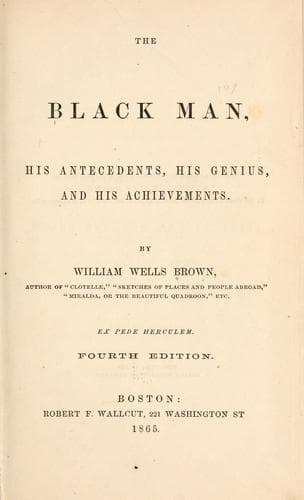
The Black Man: His Antecedents, His Genius, and His AchievementsBrown, William Wells
History
The Black Man: His Antecedents, His Genius, and His Achievements
Brown, William Wells
African Americans -- Biography
possession of it, that the heart unhesitatingly yields."
Mr. Ward visited England in 1852, where he was regarded as an eloquent
advocate of the rights of his race. He now resides at Kingston, Jamaica.
SIR EDWARD JORDAN.
Edward Jordan was born in Kingston, Jamaica, in the year 1798. After
quitting school he entered a clothing store as a clerk; but his deep
hatred to slavery, and the political and social outrages committed upon
the free colored men, preyed upon his mind to such an extent that, in
1826, he associated himself with Robert Osborn, in the publication
of _The Watchman_, a weekly newspaper devoted to the freedom and
enfranchisement of the people of color. His journal was conducted
with marked ability, and Mr. Jordan soon began to wield a tremendous
influence against the slave power. While absent from his editorial
duties, in 1830, an article appeared in _The Watchman_, upon which its
editor was indicted for constructive treason. He was at once arrested,
placed in the dock, and arraigned for trial. He pleaded "not guilty,"
and asked for time to prepare for his defence. The plea was allowed,
and the case was traversed to the next court. The trial came on at the
appointed time; the jury was packed, for the pro-slavery element had
determined on the conviction of the distinguished advocate of liberty.
The whole city appeared to be lost to every thing but the proceedings
of the assize. It was feared, that, if convicted, a riot would be the
result, and the authorities prepared for this. A vessel of war was
brought up abreast of the city, the guns of which were pointed up one
of the principal streets, and at almost every avenue leading to the
sea, a merchant vessel was moored, armed at least with one great gun,
pointing in a similar direction, to rake the streets from bottom to
top. A detachment of soldiers was kept under arms, with orders to be
ready for action at a moment's warning. The officers of the court,
including the judge, entered upon their duties, armed with pistols;
and the sheriff was instructed to shoot the prisoner in the dock if a
rescue was attempted. If convicted, Mr. Jordan's punishment was to be
death. Happily for all, the verdict was "not guilty." The acquittal of
the editor of _The Watchman_ carried disappointment and dismay into
the ranks of the slave oligarchy, while it gave a new impetus to the
anti-slavery cause, both in Jamaica and in Great Britain, and which
culminated in the abolition of slavery on the 1st of August, 1834. The
following year, Mr. Jordan was elected member of the Assembly for the
city of Kingston, which he still represents. About this time, _The
Watchman_ was converted into a daily paper, under the title of _The
Morning Journal_, still in existence, and owned by Jordan and Osborn.
In 1853, Mr. Jordan was elected mayor of his native city without
opposition, which office he still holds. He was recently chosen premier
of the island and president of the privy council.
Public-domain text, read in full here on John Shaqi.
Reviews
Reviews
No reviews yet
Be the first to share your thoughts on this work.
Elsewhere in the archive
Join the Discussion
Join the discussion
Sign in to leave a comment or review.
Sign InorCreate an account