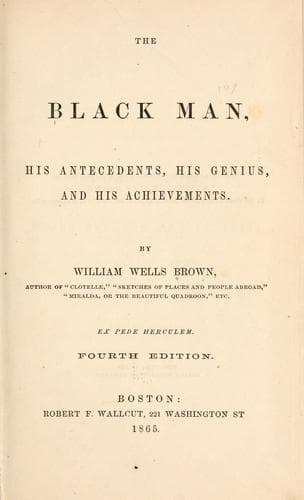
The Black Man: His Antecedents, His Genius, and His AchievementsBrown, William Wells
History
The Black Man: His Antecedents, His Genius, and His Achievements
Brown, William Wells
African Americans -- Biography
James Lawson was born in slavery in the State of Virginia, where, for
many years, he was the chief man on his master's plantation; and when
the rebellion broke out, the rebel owner felt sure, from James's former
fidelity, that he would stand by him in that contest. So confident was
he of this, that he sent the chattel to an important military station
with the following recommendation: "You may trust Jim in any way that
you can use him, for he has been my slave fourteen years, and I never
knew him to deceive me or any member of my family. Indeed, I have more
respect, esteem, and good feeling for him, and more confidence in
his integrity, than any white man of my acquaintance. He is able to
undertake any affair, of either great or small importance."
When the history of the "Slaveholders' Rebellion" shall be impartially
written, it will be found that no class has done more good service
to the Union cause, and were more reliable in every respect, than
those who had formerly been slaves. A correspondent of the "New York
Times," writing from the head-quarters of the army of the Potomac,
July 29, 1862, says, "Some of the most valuable information McClellan
has received in regard to the position, movements and plans of the
enemy, the topography of the country, and the inclination of certain
inhabitants, has been obtained through contrabands. Even spies and
traitors have been detected, and brought before the proper authorities,
upon evidence furnished by this much-abused, but generally loyal class
of people."
Probably no ten men have done so much in the way of giving information
and performing daring acts in the enemy's immediate locality, as James
Lawson. At one time we find him mounted on horseback, riding with the
commanding general and his staff, piloting the Union forces through
the enemy's country, and at another heading a scouting party, and
saving them all from capture, by his superior knowledge of the district
through which they travelled. After doing considerable service for the
army, "Jim," as he was generally called, shipped on board the flag
gunboat Freeborn, Lieutenant Samuel Magaw commanding. An officer from
that vessel says of Jim, "He furnished Captain Magaw with much valuable
intelligence concerning the rebel movements, and, from his quiet,
every-day behavior, soon won the esteem of the commanding officer.
"Captain Magaw, shortly after Jim's arrival on board the Freeborn,
sent him upon a scouting tour through the rebel fortifications, more
to test his reliability than any thing else; and the mission, although
fraught with great danger, was executed by Jim in the most faithful
manner. Again Jim was sent into Virginia, landing at the White House,
below Mount Vernon, and going into the interior for several miles,
encountering the fire of picket guards and posted sentries, returned
in safety to the shore, and was brought off in the captain's gig, under
the fire of the rebel musketry.
Public-domain text, read in full here on John Shaqi.
Reviews
Reviews
No reviews yet
Be the first to share your thoughts on this work.
Elsewhere in the archive
Join the Discussion
Join the discussion
Sign in to leave a comment or review.
Sign InorCreate an account