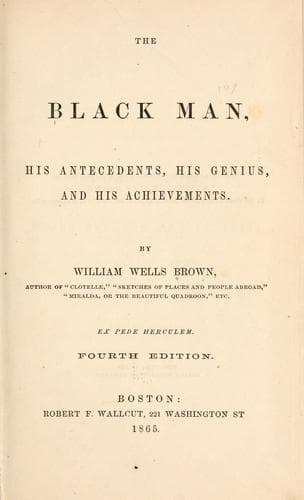
The Black Man: His Antecedents, His Genius, and His AchievementsBrown, William Wells
History
The Black Man: His Antecedents, His Genius, and His Achievements
Brown, William Wells
African Americans -- Biography
So, rather than turn him away, I put up a table there, and set him
to work. In a short time he was able to turn out as good a job as
any man in the establishment. He worked for me several years, and I
must say that I never had a better workman, or a more reliable man
in every respect, than he. Andrews often waited on my customers in
my absence, and, whether at the bench at work or behind the counter,
he was always the gentleman." I was pleased to hear so favorable
an account of Mr. Andrews, for I had formed a high opinion of him,
both as a man of integrity and a mechanic. He is now a flourishing
manufacturer himself, in Beach Street, Boston, where he can count
among his patrons some of the first families in the city. Mr. Carter,
therefore, had energy similar to Mr. Andrews, and kept applying till he
obtained work. A writer, to whom I am indebted for the early history
of my subject, says, "Two years after his arrival we find Carter in
business, manufacturing all sorts of furniture, from a pine table to
the rarest cabinet. In 1859 we find him building organs for churches.
One of the principal churches in this city (Philadelphia) has an organ
manufactured by him. The whole work is done by his own hands; the rough
stuff enters his establishment, and leaves it a perfect specimen of
art and ingenuity, pure and mellow in tone, and polished, and carved,
and elegantly finished. Unlike those extensive manufactories having
branches and departments for fashioning the various portions of such
instruments, his has none. You know it is said of the ancient Egyptians
that their sculpture had an odd and awkward appearance, because their
sculptors never chiselled out an entire figure. Some made the arms,
some the legs, some the body, some the head. Perhaps Mr. Carter has
the advantage of more extensive manufacturers by giving uniqueness
and symmetry to his instruments. He is now making a very large one to
order, having nine stops and pedals. The one he proposes to send to
the Art Exhibition is an elaborately finished one of five stops and
pedals, of walnut, carved, gothic style, and of exceeding richness of
tone. This business he has taken up without ever receiving an hour's
instruction. He was imperceptibly drawn into it through a fondness for
music. He purchased a melodeon for his own use and amusement, and
feeling the want of more stops and pedals, set about the work; and this
attempt not being satisfactory, he built an organ which proved to be a
very excellent one."
JAMES LAWSON.
Public-domain text, read in full here on John Shaqi.
Reviews
Reviews
No reviews yet
Be the first to share your thoughts on this work.
Elsewhere in the archive
Join the Discussion
Join the discussion
Sign in to leave a comment or review.
Sign InorCreate an account