The Black Man: His Antecedents, His Genius, and His Achievements — John Shaqi
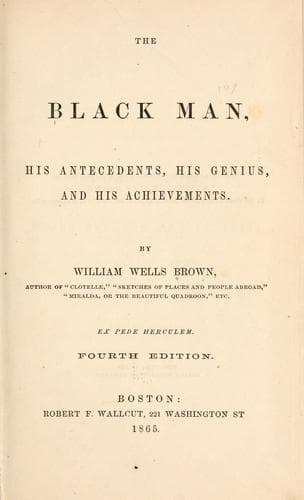
The Black Man: His Antecedents, His Genius, and His AchievementsBrown, William Wells
History
The Black Man: His Antecedents, His Genius, and His Achievements
Brown, William Wells
African Americans -- Biography
Among those who favor this opinion is our own distinguished countryman,
Alexander H. Everett, and upon this evidence I base my argument. Volney
assumes it as a settled point that the Egyptians were black. Herodotus,
who travelled extensively through that interesting land, set them down
as black, with curled hair, and having the negro features. The sacred
writers were aware of their complexion: hence the question, "Can the
Ethiopian change his skin?" The image of the negro is engraved upon
the monuments of Egypt, not as a bondman, but as the master of art.
The Sphinx, one of the wonders of the world, surviving the wreck of
centuries, exhibits these same features at the present day. Minerva,
the goddess of wisdom, was supposed to have been an African princess.
Atlas, whose shoulders sustained the globe, and even the great Jupiter
Ammon himself, were located by the mythologists in Africa. Though there
may not be much in these fables, they teach us, nevertheless, who
were then considered the nobles of the human race. Tertullian and St.
Augustin were Ethiopians. Terence, the most refined and accomplished
scholar of his time, was of the same race. Hanno, the father of
Hamilcar, and grandfather of Hannibal, was a negro. These are the
antecedents of the enslaved blacks on this continent.
From whence sprang the Anglo-Saxon? For, mark you, it is he that denies
the equality of the negro. "When the Britons first became known to the
Tyrian mariners," says Macaulay, "they were little superior to the
Sandwich Islanders."
Hume says they were a rude and barbarous people, divided into numerous
tribes, dressed in the skins of wild beasts. Druidism was their
religion, and they were very superstitious. Such is the first account
we have of the Britons. When the Romans invaded that country, they
reduced the people to a state of vassalage as degrading as that of
slavery in the Southern States. Their king, Caractacus, was captured
and sent a slave to Rome. Still later, Hengist and Horsa, the Saxon
generals, presented another yoke, which the Britons were compelled to
wear. But the last dregs of the bitter cup of humiliation were drunk
when William of Normandy met Harold at Hastings, and, with a single
blow, completely annihilated the nationality of the Britons. Thousands
of the conquered people were then sent to the slave markets of Rome,
where they were sold very cheap on account of their inaptitude to learn.
This is not very flattering to the President's ancestors, but it is
just. Cæsar, in writing home, said of the Britons, "They are the
most ignorant people I ever conquered. They cannot be taught music."
Cicero, writing to his friend Atticus, advised him not to buy slaves
from England, "because," said he, "they cannot be taught to read, and
are the ugliest and most stupid race I ever saw." I am sorry that Mr.
Lincoln came from such a low origin; but he is not to blame. I only
find fault with him for making mouths at me.
Public-domain text, read in full here on John Shaqi.
Reviews
Reviews
No reviews yet
Be the first to share your thoughts on this work.
Join the Discussion
Join the discussion
Sign in to leave a comment or review.
Sign InorCreate an account