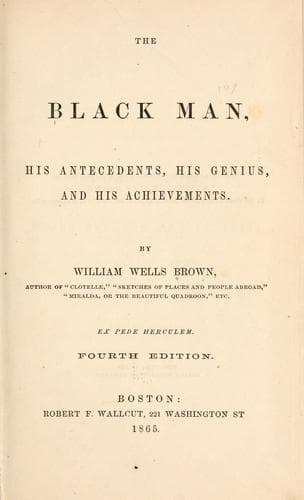
The Black Man: His Antecedents, His Genius, and His AchievementsBrown, William Wells
History
The Black Man: His Antecedents, His Genius, and His Achievements
Brown, William Wells
African Americans -- Biography
"One of the two boats entered was manned by six contraband seamen,
beautifully attired in man-of-war costume, and the other was manned by
eight white seamen, who were considered the crack crew of these waters.
Distance was offered the contraband crew, who had only been seamen some
three months; but their captain refused to accept of any advantage
whatever, and insisted on giving the white seamen the advantage of
two men. Every thing being in readiness, the word was given, and off
went the boats, throwing the crowd, white and black, into the most
intense excitement. Judge of the astonishment of all, when the boat
containing the contrabands was seen to turn the mile post first; and
great was the excitement and deafening were the cheers as they came in
some three rods in advance of the white crew, who were dripping with
perspiration, and thoroughly mortified at the unexpected result. They
were inclined to think the contest an unfair one, until the captain of
the contrabands offered to renew the race by having the crews exchange
boats, which proposition was not accepted by the white seamen for fear
of a like result. The captain said his contrabands could not only pull
a small boat faster and with more steadiness than the same number of
white seamen, but that they, with others he had on board, could man his
big guns with more agility and skill in time of action than any white
seamen he had ever seen."
Mr. Lawson, at last accounts, was holding a prominent office in General
Foster's command.
CAPTAIN CALLIOUX.
"In war was never lion's rage so fierce;
In peace was never gentle lamb more mild."
SHAKSPEARE.
Revolutions are occasioned by the growth of society beyond the growth
of government, and they will be peaceful or violent just in proportion
as the people and government shall be wise and virtuous or vicious
and ignorant. Such revolutions or reforms are generally of a peaceful
nature in communities in which the government has made provision for
the gradual expansion of its institutions, to suit the onward march
of society. No government is wise in overlooking, whatever may be the
strength of its own traditions, or however glorious its history, that
human institutions will outlive their time; that those institutions
which have been adapted for a barbarous state of society, will cease
to be adapted for more civilized and intelligent times; and unless
government make a provision for the gradual expansion, nothing can
prevent a storm, either of an intellectual or a physical nature.
Public-domain text, read in full here on John Shaqi.
Reviews
Reviews
No reviews yet
Be the first to share your thoughts on this work.
Elsewhere in the archive
Join the Discussion
Join the discussion
Sign in to leave a comment or review.
Sign InorCreate an account