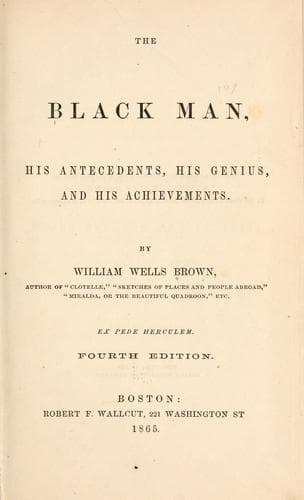
The Black Man: His Antecedents, His Genius, and His AchievementsBrown, William Wells
History
The Black Man: His Antecedents, His Genius, and His Achievements
Brown, William Wells
African Americans -- Biography
The great American rebellion, therefore, is a legitimate revolution
growing out of the incongruity of freedom and slavery; and the first
gun fired at Sumter was hailed by every true friend of freedom, and
especially the negro, as the dawn of a brighter day for the black
man. But it was evident, from the commencement of the clash of arms,
that the despised race was to take no part in their exercise, unless
the Federal authorities were forced into it by the magnitude of the
rebellion. His services refused by the Federal government, all classes
declaring that they would not "_fight by the side of a nigger_," the
black man had nothing to do but to fold his arms and bide his time.
Defeat after defeat appeared to make no change in the pro-slavery
public mind, for the nation seemed determined to perish rather than
receive help from a black hand. The rout at Bull Run, the sad affair
at Ball's Bluff, the unfortunate mistake at Big Bethel, the loss of
100,000 brave men during the first fifteen months of the rebellion, and
the display of Copperhead feeling in the Northern States, caused the
far-seeing ones to feel that the ship of state was fast drifting to sea
without a rudder. The announcement that a proclamation of emancipation
would be issued on the 1st of January, 1863, brought forth a howl of
denunciation from those who despised the negro more than they did the
rebels. Still the cry rose from the majority, "Let the republic perish
rather than see the nigger in uniform."
All this time, the black man was silently, yet steadily, creating an
under-current, which was, at a later day, to carry him to the battle
field. The heroic act of Tillman on the high seas, the "_strategy_"
of Captain Small in taking the Planter past the guns of Sumter, and
the reliable intelligence conveyed to the Union army by "intelligent
contrabands,"--all tended to soften the negro hate, and to pave the way
for justice. All honor to the "New York Tribune," for its noble defence
of my race, and its advocacy of the black man's right to bear arms.
The organization of negro regiments once begun by General Hunter, soon
found favor with the more liberal portion of the northern people.
By and by, that brave, generous, and highly cultivated scholar,
gentleman, and Christian, Thomas Wentworth Higginson, lent the
influence of his name, and accepted an office in the first South
Carolina regiment, made an excursion into the heart of slavery, met the
rebels and defeated them with his negro soldiers, and reported through
the public journals what he had witnessed of the black man's ability on
the field of battle. Then the tide begun to turn.
Public-domain text, read in full here on John Shaqi.
Reviews
Reviews
No reviews yet
Be the first to share your thoughts on this work.
Elsewhere in the archive
Join the Discussion
Join the discussion
Sign in to leave a comment or review.
Sign InorCreate an account