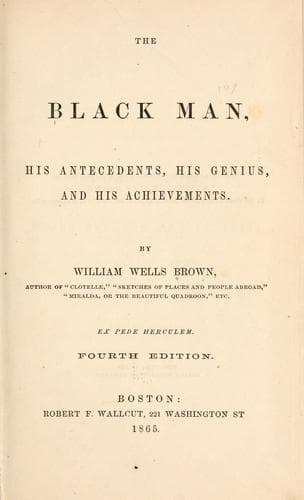
The Black Man: His Antecedents, His Genius, and His AchievementsBrown, William Wells
History
The Black Man: His Antecedents, His Genius, and His Achievements
Brown, William Wells
African Americans -- Biography
The black forces consisted of the first Louisiana, under
Lieutenant-Colonel Bassett, and the third Louisiana, under Colonel
Nelson. These officers were white, but the line officers of the first
Louisiana were colored. The number of the colored troops was 1080
strong, and formed into four lines, Lieutenant-Colonel Bassett, first
Louisiana, forming the first line, and the others forming the second
line. As the moment of attack drew near, the greatest suppressed
excitement existed, but all were eager for the fight. Captain Callioux
walked proudly up and down the line, and smilingly greeted the
familiar faces of his company. Colonel Nelson being called to act as
brigadier-general, Lieutenant-Colonel Finnegas took his place. The
third Louisiana was composed mostly of freed men, whose backs still
bore the marks of the lash, and whose brave, stout hearts beat high at
the thought that the hour had come when they were to meet their proud
and unfeeling oppressors. New England officers and privates looked on,
and asked each other what they thought would be the result. Would these
blacks stand fire? Was not the test by which they were to be tried too
severe?
The enemy, in his stronghold, felt his power, and bade defiance to
the expected attack. At last, the welcome word was given, and our men
started. The enemy opened a blistering fire of shell, canister, grape,
and musketry. The first shell thrown by the enemy killed and wounded a
number of the blacks; but on they went. "Charge" was the word--
"'Charge!' Trump and drum awoke;
Onward the bondmen broke;
Bayonet and sabre-stroke
Vainly opposed their rush."
At every pace the column was thinned by the falling dead and wounded.
The negroes closed up steadily as their comrades fell, and advanced
within fifty paces of where the rebels were working a masked battery,
situated on a bluff where the guns could sweep the whole field over
which the troops must charge. This battery was on the left of the
charging line. Another battery of three or four guns commanded the
front, and six heavy pieces raked the right of the line as it formed,
and enfiladed its flank and rear as it charged on the bluff. It was
ascertained that a bayou ran under the bluff where the guns lay--a
bayou deeper than a man could ford. This charge was repulsed with
severe loss.
Public-domain text, read in full here on John Shaqi.
Reviews
Reviews
No reviews yet
Be the first to share your thoughts on this work.
Elsewhere in the archive
Join the Discussion
Join the discussion
Sign in to leave a comment or review.
Sign InorCreate an account