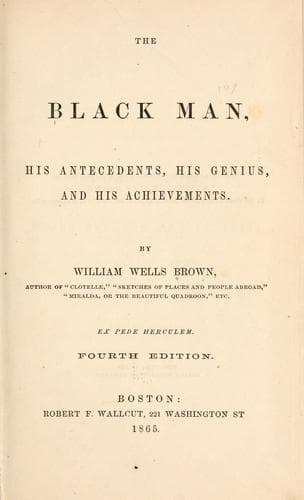
The Black Man: His Antecedents, His Genius, and His AchievementsBrown, William Wells
History
The Black Man: His Antecedents, His Genius, and His Achievements
Brown, William Wells
African Americans -- Biography
The census of 1860 placed the number of the inhabitants of the city
of New Orleans at 175,000. Of these, 15,000 were free colored, 10,000
were slaves, and the remainder were whites. The free colored men were
taxed for an average of $1000 to each person, while the white were
taxed for only $732 to each person. The first Louisiana regiment was
composed principally of this class of the free black population. The
professions, the mercantile, and the trades were well represented,
while not a few were men of extreme wealth. Nearly all were liberally
educated; some were scholars of a high order. The brave, the
enthusiastic, and the patriotic found full scope for the development
of their powers in this regiment. One of the most efficient of the
officers was Captain Callioux, a man whose identity with his race
could never be mistaken, for he prided himself on being the blackest
individual in the Crescent City. Whether in the drawing-room or on the
parade, he was ever the centre of attraction. Finely educated, polished
in his manners, a splendid horseman, a good boxer, bold, athletic,
and daring, he never lacked admirers. His men were ready at any time
to follow him to the cannon's mouth; and he was as ready to lead them.
General Banks granted their request, and the regiment was brought
before the rifle pits and heavy guns of Port Hudson on the 26th of May,
1863. Night fell--the lovely southern night, with its silvery moonshine
on the gleaming waters of the Mississippi, that passed directly by the
intrenched town. The glistening stars appeared suspended in the upper
air as globes of liquid light, with its fresh, soft breeze, bearing
such sweet scents from the odoriferous trees and plants, that a poet
might have fancied angelic spirits were abroad, making the atmosphere
luminous with their pure presence, and every breeze fragrant with
their luscious breath. The deep-red sun that rose on the next morning
indicated that the day would be warm, and, as it advanced, the heat
became intense. The earth had been long parched, and the hitherto
green verdure had begun to turn yellow. Clouds of dust followed every
step and movement of the troops. The air was filled with dust; clouds
gathered, frowned upon the earth, and hastened away. The weatherwise
watched the red masses of the morning, and still hoped for a shower
to cool the air and lay the dust, before the work of death commenced;
but none came, and the very atmosphere seemed as if it was from an
overheated oven. The laying aside of all unnecessary accoutrements,
and the preparation that showed itself on every side, told all present
that the conflict was near at hand. General Dwight was the officer in
command over the colored brigade, and his antecedents with regard to
the rights and the ability of the negro were not of the most favorable
character, and busy rumor, that knows every thing, had whispered it
about, that the valor of the black man was to be put to the severest
test that day.
Public-domain text, read in full here on John Shaqi.
Reviews
Reviews
No reviews yet
Be the first to share your thoughts on this work.
Elsewhere in the archive
Join the Discussion
Join the discussion
Sign in to leave a comment or review.
Sign InorCreate an account