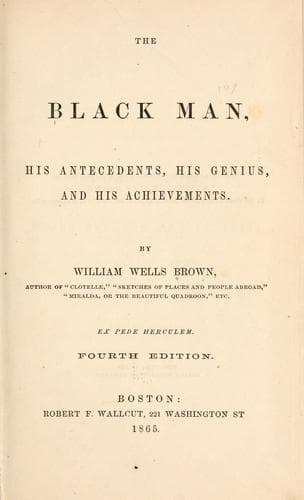
The Black Man: His Antecedents, His Genius, and His AchievementsBrown, William Wells
History
The Black Man: His Antecedents, His Genius, and His Achievements
Brown, William Wells
African Americans -- Biography
He knew every branch of history, both natural and civil; he had read
all the original historians of England, France, and Germany, and
was a great antiquarian. Criticism, metaphysics, morals, politics,
voyages and travels, were all studied and well digested by him. With
such a fund of knowledge his conversation was equally interesting,
instructive, and entertaining. Banneker was so favorably appreciated
by the first families in Virginia, that in 1803 he was invited by
Mr. Jefferson, then President of the United States, to visit him at
Monticello, where the statesman had gone for recreation. But he was
too infirm to undertake the journey. He died the following year, aged
seventy-two. Like the golden sun that has sunk beneath the western
horizon, but still throws upon the world, which he sustained and
enlightened in his career, the reflected beams of his departed genius,
his name can only perish with his language.
Banneker believed in the divinity of reason, and in the omnipotence of
the human understanding with Liberty for its handmaid. The intellect
impregnated by science and multiplied by time, it appeared to him, must
triumph necessarily over all the resistance of matter. He had faith in
liberty, truth, and virtue. His remains still rest in the slave state
where he lived and died, with no stone to mark the spot or tell that it
is the grave of Benjamin Banneker.
He labored incessantly, lived irreproachably, and died in the literary
harness, universally esteemed and regretted.
NAT TURNER.
Biography is individual history, as distinguished from that of
communities, of nations, and of worlds. Eulogy is that deserved
applause which springs from the virtues and attaches itself to the
characters of men. This is not intended either as a biography or a
eulogy, but simply a sketch of one whose history has hitherto been
neglected, and to the memory of whom the American people are not
prepared to do justice.
On one of the oldest and largest plantations in Southampton county,
Virginia, owned by Benjamin Turner, Esq., Nat was born a slave, on
the 2d of October, 1800. His parents were of unmixed African descent.
Surrounded as he was by the superstition of the slave quarters, and
being taught by his mother that he was born for a prophet, a preacher,
and a deliverer of his race, it was not strange that the child should
have imbibed the principles which were afterwards developed in his
career. Early impressed with the belief that he had seen visions, and
received communications direct from God, he, like Napoleon, regarded
himself as a being of destiny. In his childhood Nat was of an amiable
disposition; but circumstances in which he was placed as a slave,
brought out incidents that created a change in his disposition, and
turned his kind and docile feeling into the most intense hatred to the
white race.
Public-domain text, read in full here on John Shaqi.
Reviews
Reviews
No reviews yet
Be the first to share your thoughts on this work.
Join the Discussion
Join the discussion
Sign in to leave a comment or review.
Sign InorCreate an account