The Black Man: His Antecedents, His Genius, and His Achievements — John Shaqi
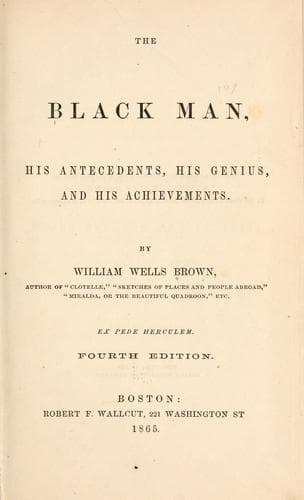
The Black Man: His Antecedents, His Genius, and His AchievementsBrown, William Wells
History
The Black Man: His Antecedents, His Genius, and His Achievements
Brown, William Wells
African Americans -- Biography
Both the young slave and his friends averred that a full knowledge
of the alphabet came to him in a single night. Impressed with the
belief that his mission was a religious one, and this impression
strengthened by the advice of his grandmother, a pious but ignorant
woman, Nat commenced preaching when about twenty-five of age, but never
went beyond his own master's locality. In stature he was under the
middle size, long armed, round-shouldered, and strongly marked with
the African features. A gloomy fire burned in his looks, and he had a
melancholy expression of countenance. He never tasted a drop of ardent
spirits in his life, and was never known to smile. In the year 1828 new
visions appeared to Nat, and he claimed to have direct communication
with God. Unlike most of those born under the influence of slavery, he
had no faith in conjuring, fortune-telling, or dreams, and always spoke
with contempt of such things. Being hired out to cruel masters, he ran
away, and remained in the woods thirty days, and could have easily
escaped to the free states, as did his father some years before; but he
received, as he says in his confession a communication from the spirit,
which said, "Return to your earthly master, for he who knoweth his
Master's will, and doeth it not, shall be beaten with many stripes."
It was not the will of his earthly, but his heavenly Master that he
felt bound to do, and therefore Nat returned. His fellow-slaves were
greatly incensed at him for coming back, for they knew well his ability
to reach Canada, or some other land of freedom, if he was so inclined.
He says further, "About this time I had a vision, and saw white spirits
and black spirits engaged in battle, and the sun was darkened, the
thunder rolled in the heavens, and blood flowed in streams; and I heard
a voice saying, 'Such is your luck; such are you called on to see; and
let it come, rough or smooth, you must surely bear it.'" Some time
after this, Nat had, as he says, another vision, in which the spirit
appeared and said, "The serpent is loosened, and Christ has laid down
the yoke he has borne for the sins of men, and you must take it up,
and fight against the serpent, for the time is fast approaching when
the first shall be last, and the last shall be first." There is no
doubt but that this last sentence filled Nat with enthusiastic feeling
in favor of the liberty of his race, that he had so long dreamed of.
"The last shall be first, and the first shall be last," seemed to him
to mean something. He saw in it the overthrow of the whites, and the
establishing of the blacks in their stead, and to this end he bent
the energies of his mind. In February, 1831, Nat received his last
communication, and beheld his last vision. He said, "I was told I
should arise and prepare myself, and slay my enemies with their own
weapons."
Public-domain text, read in full here on John Shaqi.
Reviews
Reviews
No reviews yet
Be the first to share your thoughts on this work.
Join the Discussion
Join the discussion
Sign in to leave a comment or review.
Sign InorCreate an account