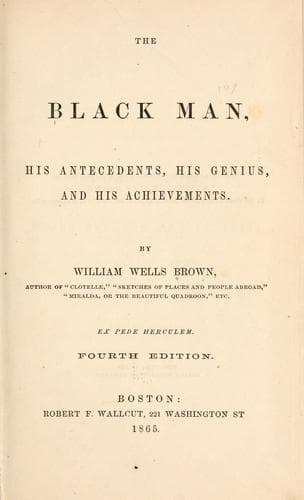
The Black Man: His Antecedents, His Genius, and His AchievementsBrown, William Wells
History
The Black Man: His Antecedents, His Genius, and His Achievements
Brown, William Wells
African Americans -- Biography
Many of the planters sent their mulatto sons to France to be educated.
When these young men returned to the island, they were greatly
dissatisfied at the proscription which met them wherever they appeared.
White enough to make them hopeful and aspiring, many of the mulattoes
possessed wealth enough to make them influential. Aware, by their
education, of the principles of freedom that were being advocated in
Europe and the United States, they were ever on the watch to seize
opportunities to better their social and political condition. In the
French part of the island alone, twenty thousand whites lived in the
midst of thirty thousand free mulattoes and five hundred thousand
slaves. In the Spanish portion, the odds were still greater in favor of
the slaves. Thus the advantage of numbers and physical strength was on
the side of the oppressed. Right is the most dangerous of weapons--woe
to him who leaves it to his enemies!
The efforts of Wilberforce, Sharp, Buxton, and Clarkson to abolish
the African slave trade, and their advocacy of the equality of the
races, were well understood by the men of color. They had also learned
their own strength in the island, and that they had the sympathy of
all Europe with them. The news of the oath of the Tennis Court and the
taking of the Bastile at Paris was received with the wildest enthusiasm
by the people of St. Domingo.
The announcement of these events was hailed with delight by both the
white planters and the mulattoes; the former, because they hoped
that a revolution in the mother country would secure to them the
independence of the colony; the latter, because they viewed it as a
movement that would give them equal rights with the whites; and even
the slaves regarded it as a precursor to their own emancipation. But
the excitement which the outbreak at Paris had created amongst the
free men of color and the slaves, at once convinced the planters that
a separation from France would be the death-knell of slavery in St.
Domingo.
Although emancipated by law from the dominion of individuals, the
mulattoes had no rights: shut out from society by their color, deprived
of religious and political privileges, they felt their degradation even
more keenly than the bond slaves. The mulatto son was not allowed to
dine at his father's table, kneel with him in his devotions, bear his
name, inherit his property, nor even to lie in his father's graveyard.
Laboring as they were under the sense of their personal social wrongs,
the mulattoes tolerated, if they did not encourage, low and vindictive
passions. They were haughty and disdainful to the blacks, whom they
scorned, and jealous and turbulent to the whites, whom they hated and
feared.
Public-domain text, read in full here on John Shaqi.
Reviews
Reviews
No reviews yet
Be the first to share your thoughts on this work.
Elsewhere in the archive
Join the Discussion
Join the discussion
Sign in to leave a comment or review.
Sign InorCreate an account