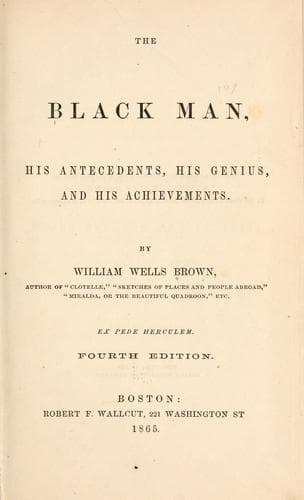
The Black Man: His Antecedents, His Genius, and His AchievementsBrown, William Wells
History
The Black Man: His Antecedents, His Genius, and His Achievements
Brown, William Wells
African Americans -- Biography
The mulattoes at once despatched one of their number to Paris, to lay
before the Constitutional Assembly their claim to equal rights with
the whites. Vincent Ogé, their deputy, was well received at Paris
by Lafayette, Brissot, Barnave, and Gregoire, and was admitted to a
seat in the Assembly, where he eloquently portrayed the wrongs of his
race. In urging his claims, he said, if equality was withheld from the
mulattoes, they would appeal to force. This was seconded by Lafayette
and Barnave, who said, "_Perish the colonies rather than a principle_."
The Assembly passed a decree granting the demands of the men of color,
and Ogé was made bearer of the news to his brethren. The planters armed
themselves, met the young deputy on his return to the island, and a
battle ensued. The free colored men rallied around Ogé, but they were
defeated and taken, with their brave leader, were first tortured, and
then broken alive on the wheel.
The prospect of freedom was put down for the time, but the blood of Ogé
and his companions bubbled silently in the hearts of the African race;
they swore to avenge them.
The announcement of the death of Ogé in the halls of the Assembly
at Paris created considerable excitement, and became the topic of
conversation in the clubs and on the Boulevards. Gregoire defended the
course of the colored men, and said, "If Liberty was right in France,
it was right in St. Domingo." He well knew that the crime for which Ogé
had suffered in the West Indies, had constituted the glory of Mirabeau
and Lafayette at Paris, and Washington and Hancock in the United
States. The planters in the island trembled at their own oppressive
acts, and terror urged them on to greater violence. The blood of Ogé
and his accomplices had sown every where despair and conspiracy. The
French sent an army to St. Domingo to enforce the laws.
The planters repelled with force the troops sent out by France,
denying its prerogatives and refusing the civic oath. In the midst of
these thickening troubles, the planters who resided in France were
invited to return and assist in vindicating the civil independence of
the island. Then was it that the mulattoes earnestly appealed to the
slaves, and the result was appalling. The slaves awoke as from an
ominous dream, and demanded their rights with sword in hand. Gaining
immediate success, and finding that their liberty would not be granted
by the planters, they rapidly increased in numbers; and in less than a
week from its commencement, the storm had swept over the whole plain
of the north, from east to west, and from the mountains to the sea.
The splendid villas and rich factories yielded to the furies of the
devouring flames; so that the mountains, covered with smoke and burning
cinders, borne upwards by the wind, looked like volcanoes; and the
atmosphere, as if on fire, resembled a furnace.
Public-domain text, read in full here on John Shaqi.
Reviews
Reviews
No reviews yet
Be the first to share your thoughts on this work.
Elsewhere in the archive
Join the Discussion
Join the discussion
Sign in to leave a comment or review.
Sign InorCreate an account