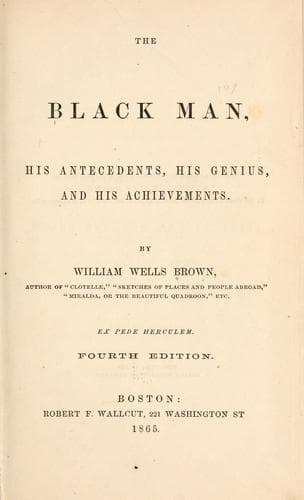
The Black Man: His Antecedents, His Genius, and His AchievementsBrown, William Wells
History
The Black Man: His Antecedents, His Genius, and His Achievements
Brown, William Wells
African Americans -- Biography
The principle that taxation and representation were inseparable was
in accordance with the theory, the genius, and the precedents of
British legislation; and this principle was now, for the first time,
intentionally invaded. The American colonies were not represented
in Parliament; yet an act was passed by that body, the tendency of
which was to invalidate all right and title to their property. This
was the "Stamp Act," of March 23, 1765, which ordained that no sale,
bond, note of hand, or other instrument of writing should be valid
unless executed on paper bearing the stamp prescribed by the home
government. The intelligence of the passage of the stamp act at once
roused the indignation of the liberty-loving portion of the people
of the colonies, and meetings were held at various points to protest
against this high-handed measure. Massachusetts was the first to take
a stand in opposition to the mother country. The merchants and traders
of Boston, New York, and Philadelphia entered into non-importation
agreements, with a view of obtaining a repeal of the obnoxious law.
Under the pressure of public sentiment, the stamp act officers gave
in their resignations. The eloquence of William Pitt and the sagacity
of Lord Camden brought about a repeal of the stamp act in the British
Parliament. A new ministry, in 1767, succeeded in getting through the
House of Commons a bill to tax the tea imported into the American
colonies, and it received the royal assent. Massachusetts again took
the lead in opposing the execution of this last act, and Boston began
planning to take the most conspicuous part in the great drama. The
agitation in the colonies provoked the home government, and power
was given to the governor of Massachusetts to take notice of all
persons who might offer any treasonable objections to these oppressive
enactments, that the same might be sent home to England to be tried
there. Lord North was now at the head of affairs, and no leniency was
to be shown to the colonies. The concentration of British troops in
large numbers at Boston convinced the people that their liberties were
at stake, and they began to rally. A crowded and enthusiastic meeting,
held in Boston in the latter part of the year 1769, was addressed by
the ablest talent that the progressive element could produce. Standing
in the back part of the hall, eagerly listening to the speakers, was a
dark mulatto man, very tall, rather good looking, and apparently about
fifty years of age. This was Crispus Attucks. Though taking no part
in the meeting, he was nevertheless destined to be conspicuous in the
first struggle in throwing off the British yoke. Twenty years previous
to this, Attucks was the slave of William Brouno, Esq., of Framingham,
Mass.; but his was a heart beating for freedom, and not to be kept in
the chains of mental or bodily servitude.
Public-domain text, read in full here on John Shaqi.
Reviews
Reviews
No reviews yet
Be the first to share your thoughts on this work.
Elsewhere in the archive
Join the Discussion
Join the discussion
Sign in to leave a comment or review.
Sign InorCreate an account