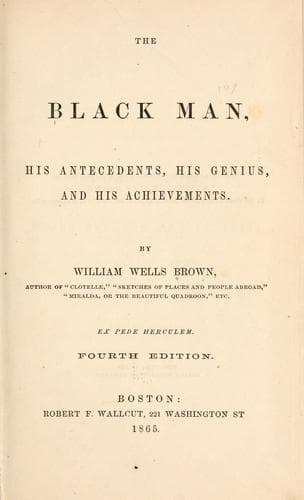
The Black Man: His Antecedents, His Genius, and His AchievementsBrown, William Wells
History
The Black Man: His Antecedents, His Genius, and His Achievements
Brown, William Wells
African Americans -- Biography
From the Boston Gazette of Tuesday, November 20, 1750, now in
the possession of William C. Nell, Esq., I copy the following
advertisement:--
"Ran away from his master William Brouno Framingham, on the 30th of
Sept., last, a Molatto Fellow, about 27 years of Age named Crispus,
well set, six feet 2 inches high, short curl'd Hair, knees nearer
together than common; had on a light coloured Bearskin Coat, brown
Fustian jacket, new Buckskin Breeches, blew yarn Stockins and Checkered
Shirt. Whoever shall take up said Run-away, and convey him to his above
said Master at Framingham, shall have Ten Pounds, old Tenor Reward and
all necessary Charges paid."
The above is a verbatim et literatim advertisement for a runaway slave
one hundred and twelve years ago. Whether Mr. Brouno succeeded in
recapturing Crispus or not, we are left in the dark.
Ill-feeling between the mother country and her colonial subjects had
been gaining ground, while British troops were concentrating at Boston.
On the 5th of March, 1770, the people were seen early congregating at
the corners of the principal streets, at Dock Square, and near the
custom house. Captain Preston, with a body of redcoats, started out for
the purpose of keeping order in the disaffected town, and was hissed at
by the crowds in nearly every place where he appeared. The day passed
off without any outward manifestation of disturbance, but all seemed
to feel that something would take place after nightfall. The doubling
of the guard in and about the custom house showed that the authorities
felt an insecurity that they did not care to express. The lamps in
Dock Square threw their light in the angry faces of a large crowd who
appeared to be waiting for the crisis, in whatever form it should
come. A part of Captain Preston's company was making its way from the
custom house, when they were met by the crowd from Dock Square, headed
by the black man Attucks, who was urging them to meet the redcoats,
and drive them from the streets. "These rebels have no business here,"
said he; "let's drive them away." The people became enthusiastic, their
brave leader grew more daring in his language and attitude, while the
soldiers under Captain Preston appeared to give way. "Come on! don't
be afraid!" cried Attucks. "They dare not shoot; and if they dare, let
them do it." Stones and sticks, with which the populace was armed,
were freely used, to the great discomfiture of the English soldiers.
"Don't hesitate! come on! We'll drive these rebels out of Boston,"
were the last words heard from the lips of the colored man, for the
sharp crack of muskets silenced his voice, and he fell weltering in
his blood. Two balls had pierced his sable breast. Thus died Crispus
Attucks, the first martyr to American liberty, and the inaugurator of
the revolution that was destined to take from the crown of George the
Third its brightest star. An immense concourse of citizens followed
the remains of the hero to its last resting place, and his name was
Public-domain text, read in full here on John Shaqi.
Reviews
Reviews
No reviews yet
Be the first to share your thoughts on this work.
Elsewhere in the archive
Join the Discussion
Join the discussion
Sign in to leave a comment or review.
Sign InorCreate an account