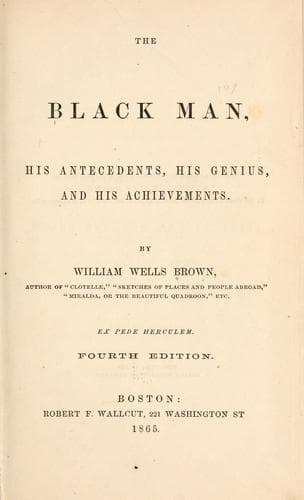
The Black Man: His Antecedents, His Genius, and His AchievementsBrown, William Wells
History
The Black Man: His Antecedents, His Genius, and His Achievements
Brown, William Wells
African Americans -- Biography
On looking over the columns of _The Times_, one morning, I saw it
announced under the head of "Amusements," that "Ira Aldridge, the
African Roscius," was to appear in the character of Othello, in
Shakspeare's celebrated tragedy of that name, and, having long wished
to see my sable countryman, I resolved at once to attend. Though
the doors had been open but a short time when I reached the Royal
Haymarket, the theatre where the performance was to take place, the
house was well filled, and among the audience I recognized the faces of
several distinguished persons of the nobility, the most noted of whom
was Sir Edward Bulwer Lytton, the renowned novelist--his figure neat,
trim, hair done up in the latest fashion--looking as if he had just
come out of a band-box. He is a great lover of the drama, and has a
private theatre at one of his country seats, to which he often invites
his friends, and presses them into the different characters.
As the time approached for the curtain to rise, it was evident that
the house was to be "jammed." Stuart, the best Iago since the days of
Young, in company with Roderigo, came upon the stage as soon as the
green curtain went up. Iago looked the villain, and acted it to the
highest conception of the character. The scene is changed, all eyes are
turned to the right door, and thunders of applause greet the appearance
of Othello. Mr. Aldridge is of the middle size, and appeared to be
about three quarters African; has a pleasant countenance, frame well
knit, and seemed to me the best Othello that I had ever seen. As Iago
began to work upon his feelings, the Moor's eyes flashed fire, and,
further on in the play, he looked the very demon of despair. When he
seized the deceiver by the throat, and exclaimed, "Villain! be sure
thou prove my love false: be sure of it--give me the ocular proof--or,
by the worth of my eternal soul, thou hadst better have been born a
dog, Iago, than answer my waked wrath," the audience, with one impulse,
rose to their feet amid the wildest enthusiasm. At the end of the third
act, Othello was called before the curtain, and received the applause
of the delighted multitude. I watched the countenance and every motion
of Bulwer Lytton with almost as much interest as I did that of the Moor
of Venice, and saw that none appeared to be better pleased than he.
The following evening I went to witness his Hamlet, and was surprised
to find him as perfect in that as he had been in Othello; for I had
been led to believe that the latter was his greatest character. The
whole court of Denmark was before us; but till the words, "'Tis not
alone my inky cloak, good mother," fell from the lips of Mr. Aldridge,
was the general ear charmed, or the general tongue arrested. The voice
was so low, and sad, and sweet, the modulation so tender, the dignity
so natural, the grace so consummate, that all yielded themselves
silently to the delicious enchantment. When Horatio told him that he
Public-domain text, read in full here on John Shaqi.
Reviews
Reviews
No reviews yet
Be the first to share your thoughts on this work.
Elsewhere in the archive
Join the Discussion
Join the discussion
Sign in to leave a comment or review.
Sign InorCreate an account