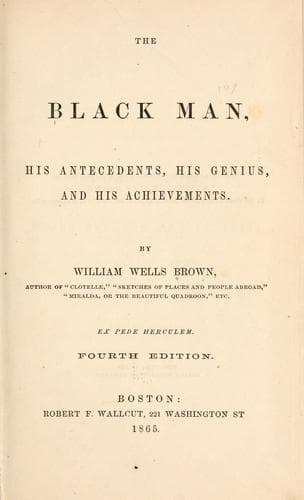
The Black Man: His Antecedents, His Genius, and His AchievementsBrown, William Wells
History
The Black Man: His Antecedents, His Genius, and His Achievements
Brown, William Wells
African Americans -- Biography
had come to see his father's funeral, the deep melancholy that took
possession of his face showed the great dramatic power of Mr. Aldridge.
"I pray thee do not mock me, fellow-student," seemed to come from his
inmost soul. The animation with which his countenance was lighted
up, during Horatio's recital of the visits that the ghost had paid
him and his companions, was beyond description. "Angels and ministers
of grace defend us," as the ghost appeared in the fourth scene, sent
a thrill through the whole assembly. His rendering of the "Soliloquy
on Death," which Edmund Kean, Charles Kemble, and William C. Macready
have reaped such unfading laurels from, was one of his best efforts.
He read it infinitely better than Charles Kean, whom I had heard at
the "Princess," but a few nights previous. The vigorous starts of
thought, which in the midst of his personal sorrows rise with such
beautiful and striking suddenness from the ever-wakeful mind of the
humanitarian philosopher, are delivered with that varying emphasis that
characterizes the truthful delineator, when he exclaims, "Frailty, thy
name is woman!" In the second scene of the second act, when revealing
to Guildenstern the melancholy which preys upon his mind, the beautiful
and powerful words in which Hamlet explains his feelings are made very
effective in Mr. Aldridge's rendering: "This most excellent canopy, the
air, the brave o'erhanging firmament, this majestical roof fretted with
golden fire.... What a piece of work is a man! How noble in reason! how
infinite in faculties! in form and moving how express and admirable! in
action how like an angel! in apprehension how like a God!" In the last
scene of the second act, when Hamlet's imagination, influenced by the
interview with the actors, suggests to his rich mind so many eloquent
reflections, Mr. Aldridge enters fully into the spirit of the scene,
warms up, and when he exclaims, "He would drown the stage with tears,
and cleave the general ear with horrid speech,--make mad the guilty,
and appall the free," he is very effective; and when this warmth mounts
into a paroxysm of rage, and he calls the King "Bloody, bawdy villain!
Remorseless, treacherous, lecherous, kindless villain!" he sweeps the
audience with him, and brings down deserved applause. The fervent soul
and restless imagination, which are ever stirring at the bottom of
the fountain, and sending bright bubbles to the top, find a glowing
reflection on the animated surface of Mr. Aldridge's colored face. I
thought Hamlet one of his best characters, though I saw him afterwards
in several others.
Public-domain text, read in full here on John Shaqi.
Reviews
Reviews
No reviews yet
Be the first to share your thoughts on this work.
Elsewhere in the archive
Join the Discussion
Join the discussion
Sign in to leave a comment or review.
Sign InorCreate an account