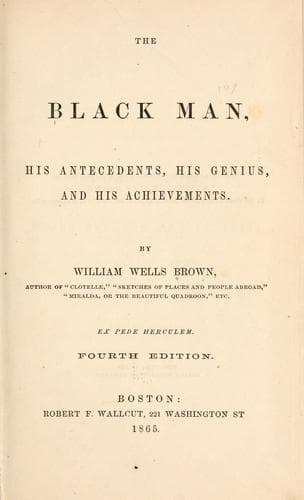
The Black Man: His Antecedents, His Genius, and His AchievementsBrown, William Wells
History
The Black Man: His Antecedents, His Genius, and His Achievements
Brown, William Wells
African Americans -- Biography
Such is the vivacity of his descriptions, such the _entrainement_ of
his narrative, such the boldness of his invention, such the point of
his dialogue, and the rapidity of his incidents, so matchless often the
felicity and skill of particular passages, that he always inflames the
interest of the reader to the end. You may be angry with him, but you
will confess that he is the opposite of tedious. Certainly no writer
fills a more prominent place in the literature of his country; and none
has exercised a more potent influence upon its recent development than
this son of the negro general, Dumas. His novels are every where, and
the enthusiasm with which his dramatic pieces were received has been of
the most flattering character.
HENRI CHRISTOPHE.
Henri Christophe was a native of the island of New Grenada, where
he was born a slave. He went to St. Domingo at the age of eighteen,
and was employed as _maître d'hôtel_ in the principal _café_ at
Cape François. From strength of natural genius, as well as from his
occupying a station in life above the ordinary condition of his race,
he acquired considerable knowledge of the prevailing manners and
customs of the society of which he was a daily spectator. He was master
of the French, English, and Spanish languages, and was thought to be
the most polished gentleman of all of Toussaint's generals. Being six
feet three inches in height, Christophe made an imposing appearance on
horseback, on the field of battle, in his uniform. He had a majestic
carriage, and an eye full of fire; and a braver man never lived. Though
far inferior to Toussaint in vigor and originality of mind, he was much
his superior in acquaintance with the customs and habits of the world,
and appeared more dignified in his intercourse with society.
After the breaking out of the revolution, Christophe joined the army
under Toussaint, who soon discovered his good qualities, and made him
his lieutenant; from which position he was soon advanced to second in
command. It has been asserted that he was an abler military man than
either Toussaint or Dessalines. When Napoleon's expedition invaded St.
Domingo, Leclerc, with the largest part of the squadron, came to anchor
off Cape City, and summoned the place to surrender. The reply which
he received from Christophe was such as to teach the captain-general
what he had to expect in the subjugation of St. Domingo. "Go, tell your
general that the French shall march here only over ashes, and that the
ground shall burn beneath their feet," was the answer that Leclerc
obtained in return to his command. The French general sent another
messenger to Christophe, urging him to surrender, and promising the
black chief a commission of high rank in the French army. But he found
he had a man, and not a slave, to deal with. The exasperated Christophe
sent back the heroic reply, "The decision of arms can admit you only
into a city in ashes, and even on these ashes will I fight still."
Public-domain text, read in full here on John Shaqi.
Reviews
Reviews
No reviews yet
Be the first to share your thoughts on this work.
Elsewhere in the archive
Join the Discussion
Join the discussion
Sign in to leave a comment or review.
Sign InorCreate an account