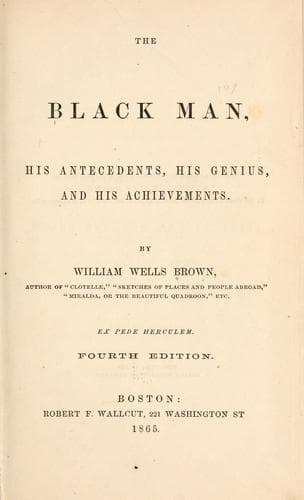
The Black Man: His Antecedents, His Genius, and His AchievementsBrown, William Wells
History
The Black Man: His Antecedents, His Genius, and His Achievements
Brown, William Wells
African Americans -- Biography
celebrated romancer were watched in the closest manner by the audience.
Even Mario appeared to feel that his part on the stage was of less
importance than that of the colored man in the royal box. M. Dumas'
grandfather was the Marquis de la Pailleterie, a wealthy planter of St.
Domingo, while his grandmother was a negress from Congo. Rainsford
makes honorable mention of the father of Dumas, in his _Black Empire_,
as having served in the army in his own native island. Dumas' father
served under Napoleon during the whole of his campaigns, and rose to
high distinction. Once, when near Lisle, Dumas, with four men, attacked
a post of fifty Austrians, killed six, and made sixteen prisoners.
For a long time he commanded a legion of horse composed of blacks and
mulattoes, who were the terror of their enemies. General Dumas was
with the army which Napoleon sent over the Alps; Napoleon crossed it
in June, Marshal Macdonald in December. The latter sent Dumas to say
it was impossible to pass in the winter, when great avalanches of snow
were falling down, threatening to destroy the army. Napoleon's reply
to the messenger was, "Go and tell Marshal Macdonald, where one man
can pass over, an army can pass over in single file. The order is not
to be countermanded." The order was obeyed, though at the cost of many
lives. One of the generals that made the pass was the black General
Dumas, who ascended the St. Bernard, which was defended by a number
of fortifications, took possession of the cannon, and immediately
directed them against the enemy. At the conclusion of the wars, the
father returned to his island home, and after his death, the son went
to France destitute, where he obtained a situation as a writer. Here
he cultivated his literary taste. His imaginative mind and unsurpassed
energies began to develop themselves, which soon placed the young man
in easy circumstances. Dumas is now sixty-three years of age, and has
been a writer for the press thirty-eight years. During this time he
has published more novels, plays, travels, and historical sketches
than any other man that ever lived. It is well understood that he is
not the author of all the works that appear under his name, but that
young writers gain a living by working out the plots and situations
that his fecund brain suggests. When the novel or the play is complete,
Dumas gives it a revision, touches up the dialogue, dashes in here
and there a spirited scene of his own, and then receives from the
publisher an enormous sum. Undeniably a man of great genius, endowed
with true fertility of imagination, and masterly power of expression,
his influence has been great.
Public-domain text, read in full here on John Shaqi.
Reviews
Reviews
No reviews yet
Be the first to share your thoughts on this work.
Elsewhere in the archive
Join the Discussion
Join the discussion
Sign in to leave a comment or review.
Sign InorCreate an account