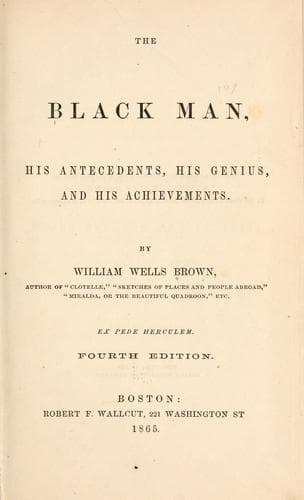
The Black Man: His Antecedents, His Genius, and His AchievementsBrown, William Wells
History
The Black Man: His Antecedents, His Genius, and His Achievements
Brown, William Wells
African Americans -- Biography
Christophe's aims were great, and many of them good. He was not only
the patron of the arts, but of industry; and it gave him pleasure to
see his country recovering the ground lost in the revolution and the
civil wars, and advancing in name and wealth. He promoted industry
on the principles laid down by his predecessor, Toussaint. A busy
population covered the land with marks of its labors. Rich crops of
the most coveted produce of nature annually rewarded the toil of the
husbandman. Christophe was also the patron of education; and there are
still on the island schools that were founded by him when king. In one
respect he excelled Charlemagne,--he could write his own name; but that
was all. He dictated letters and despatches, and was an admirable judge
of the fitness and relevancy of words. He kept up a correspondence
with Wilberforce and Clarkson, the English philanthropists, and both
of these distinguished men had a high opinion of him as a man, and a
friend of his race.
PHILLIS WHEATLEY.
In the year 1761, when Boston had her slave market, and the descendants
of the Pilgrims appeared to be the most pious and God-fearing people
in the world, Mrs. John Wheatley went into the market one day, for
the purpose of selecting and purchasing a girl for her own use. Among
the group of children just imported from the African coast was a
delicately built, rather good-looking child of seven or eight years,
apparently suffering from the recent sea voyage and change of climate.
Mrs. Wheatley's heart was touched at the interesting countenance and
humble modesty of this little stranger. The lady bought the child, and
she was named Phillis. Struck with the slave's uncommon brightness,
the mistress determined to teach her to read, which she did with no
difficulty. The child soon mastered the English language, with which
she was totally unacquainted when she landed upon the American shores.
Her school lessons were all perfect, and she drank in the scriptural
teachings as if by intuition. At the age of twelve, she could write
letters and keep up a correspondence that would have done honor to one
double her years. Mrs. Wheatley, seeing her superior genius, no longer
regarded Phillis as a servant, but took her as a companion. It was
not surprising that the slave girl should be an object of attraction,
astonishment, and attention with the refined and highly cultivated
society that weekly assembled in the drawing room of the Wheatleys. As
Phillis grew up to womanhood, her progress and attainments kept pace
with the promise of her earlier years. She drew around her the best
educated of the white ladies, and attracted the attention and notice
of the literary characters of Boston, who supplied her with books and
encouraged the ripening of her intellectual powers. She studied the
Latin tongue, and translated one of Ovid's tales, which was no sooner
put in print in America, than it was republished in London, with
eloquent commendations from the reviews.
Public-domain text, read in full here on John Shaqi.
Reviews
Reviews
No reviews yet
Be the first to share your thoughts on this work.
Elsewhere in the archive
Join the Discussion
Join the discussion
Sign in to leave a comment or review.
Sign InorCreate an account