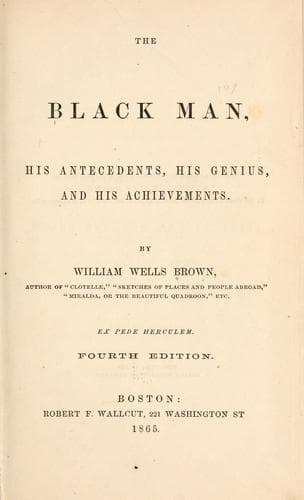
The Black Man: His Antecedents, His Genius, and His AchievementsBrown, William Wells
History
The Black Man: His Antecedents, His Genius, and His Achievements
Brown, William Wells
African Americans -- Biography
In 1773, a small volume of
her poems, containing thirty-nine pieces, was published in London, and
dedicated to the Countess of Huntingdon. The genuineness of this work
was established in the first page of the volume, by a document signed
by the governor of Massachusetts, the lieutenant-governor, her master,
and fifteen of the most respectable and influential citizens of Boston,
who were acquainted with her talents and the circumstances of her
life. Her constitution being naturally fragile, she was advised by her
physician to take a sea voyage as the means of restoring her declining
health.
Phillis was emancipated by her master at the age of twenty-one years,
and sailed for England. On her arrival, she was received and admired
in the first circles of London society; and it was at that time that
her poems were collected and published in a volume, with a portrait and
memoir of the authoress. Phillis returned to America, and married Dr.
Peters, a man of her own color, and of considerable talents. Her health
began rapidly to decline, and she died at the age of twenty-six years,
in 1780. Fortunately rescued from the fate that awaits the victims of
the slave trade, this injured daughter of Africa had an opportunity of
developing the genius that God had given her, and of showing to the
world the great wrong done to her race. The limited place allowed for
this sketch will not permit of our giving more than one short poem from
the pen of the gifted Phillis Wheatley.
ON THE DEATH OF A YOUNG GIRL.
From dark abodes to fair ethereal light,
The enraptured innocent has winged her flight;
On the kind bosom of eternal love
She finds unknown beatitudes above.
This know, ye parents, nor her loss deplore--
She feels the iron hand of pain no more;
The dispensations of unerring grace
Should turn your sorrows into grateful praise;
Let, then, no tears for her henceforward flow
Nor suffer grief in this dark vale below.
Her morning sun, which rose divinely bright,
Was quickly mantled with the gloom of night;
But hear, in heaven's best bowers, your child so fair,
And learn to imitate her language there.
Thou, Lord, whom I behold with glory crowned,
By what sweet name, and in what tuneful sound,
Wilt thou be praised? Seraphic powers are faint
Infinite love and majesty to paint.
To thee let all their grateful voices raise,
And saints and angels join their songs of praise
Public-domain text, read in full here on John Shaqi.
Reviews
Reviews
No reviews yet
Be the first to share your thoughts on this work.
Elsewhere in the archive
Join the Discussion
Join the discussion
Sign in to leave a comment or review.
Sign InorCreate an account