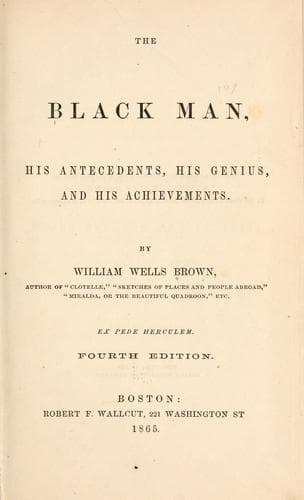
The Black Man: His Antecedents, His Genius, and His AchievementsBrown, William Wells
History
The Black Man: His Antecedents, His Genius, and His Achievements
Brown, William Wells
African Americans -- Biography
"How long, O gracious God, how long
Shall power lord it over right?
The feeble, trampled by the strong,
Remain in slavery's gloomy night?
In every region of the earth
Oppression rules with iron power;
And every man of sterling worth,
Whose soul disdains to cringe or cower
Beneath a haughty tyrant's nod,
And, supplicating, kiss the rod
That, wielded by oppression's might,
Smites to the earth his dearest right,--
The right to speak, and think, and feel,
And spread his uttered thoughts abroad,
To labor for the common weal,
Responsible to none but God,--
Is threatened with the dungeon's gloom,
The felon's cell, the traitor's doom,
And treacherous politicians league
With hireling priests to crush and ban
All who expose their vain intrigue,
And vindicate the rights of man.
How long shall Afric raise to thee
Her fettered hand, O Lord, in vain,
And plead in fearful agony
For vengeance for her children slain?
I see the Gambia's swelling flood,
And Niger's darkly-rolling wave,
Bear on their bosoms, stained with blood,
The bound and lacerated slave;
While numerous tribes spread near and far
Fierce, devastating, barbarous war,
Earth's fairest scenes in ruin laid,
To furnish victims for that trade
Which breeds on earth such deeds of shame,
As fiends might blush to hear or name."
Mr. Whitfield has written several long poems, all of them in good taste
and excellent language.
ANDRE RIGAUD.
Slavery, in St. Domingo, created three classes--the white planters,
the free mulattoes, and the slaves, the latter being all black. The
revolution brought out several valiant chiefs among the mulattoes,
their first being Vincent Ogé. This man was not calculated for a
leader of rebellion. His mother having been enabled to support him in
France as a gentleman, he had cherished a delicacy of sentiment very
incompatible with the ferocity of revolt. But Andre Rigaud, their next
and greatest chief, was a far different man. A native of Aux Cayes,
educated at Bourdeaux, and afterwards spending some time at Paris,
maturing his mind amid scenes of science and literature, Rigaud's
position among his followers was an exalted one. His father was white
and his mother black. He was tall and slim, with features beautifully
defined. Nature had been profligate in bestowing her gifts upon him.
Public-domain text, read in full here on John Shaqi.
Reviews
Reviews
No reviews yet
Be the first to share your thoughts on this work.
Elsewhere in the archive
Join the Discussion
Join the discussion
Sign in to leave a comment or review.
Sign InorCreate an account