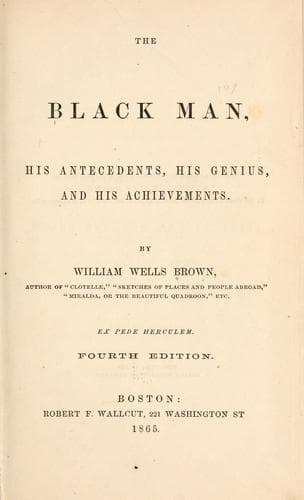
The Black Man: His Antecedents, His Genius, and His AchievementsBrown, William Wells
History
The Black Man: His Antecedents, His Genius, and His Achievements
Brown, William Wells
African Americans -- Biography
While at the Military School at Paris, besides being introduced into
good society, he became acquainted with Lafayette, Condorcet, Gregoire,
and other distinguished statesmen, and his manners were polished
and his language elegant. In religion he was the very opposite of
Toussaint. An admirer of Voltaire and Rousseau, he had made their works
his study. A long residence in the French metropolis had enabled him
to become acquainted with the followers of these two distinguished
philosophers. He had seen two hundred thousand persons following the
bones of Voltaire, when removed to the Pantheon, and, in his admiration
for the great author, had confounded liberty with infidelity. In Asia,
he would have governed an empire; in St. Domingo, he was scarcely more
than an outlawed chief; but he had in his soul the elements of a great
man. In military science, horsemanship, and activity, Rigaud was the
first man on the island, of any color. Toussaint bears the following
testimony to the great skill of the mulatto general: "I know Rigaud
well. He leaps from his horse when at full gallop, and he puts all
his force in his arm when he strikes a blow." He was high-tempered,
irritable, and haughty. The charmed power that he held over the men
of his color can scarcely be described. At the breaking out of the
revolution, he headed the mulattoes in his native town, and soon drew
around him a formidable body of men.
After driving the English and Spaniards from the island, and subduing
the French planters, Toussaint and Rigaud made war upon each other.
As the mulattoes were less than fifty thousand in number, and the
blacks more than five hundred thousand, Rigaud was always outnumbered
on the field of battle; but his forces, fighting under the eyes of
the general whom they adored, defended their territory with vigor, if
not with success. Reduced in his means of defence by the loss of so
many brave men in his recent battles, Rigaud had the misfortune to
see his towns fall, one after another, into the power of Toussaint,
until he was driven to the last citadel of his strength--the town of
Aux Cayes. As he thus yielded foot by foot, every thing was given to
desolation before it was abandoned, and the land, which under his
active government had just before been so adorned with cultivation, was
made such a waste of desolation, that, according almost to the very
letter of his orders, "the trees were turned with their roots in the
air." The genius and activity of Toussaint were completely at fault in
his attempt to force the mulatto general from his intrenchments.
Public-domain text, read in full here on John Shaqi.
Reviews
Reviews
No reviews yet
Be the first to share your thoughts on this work.
Elsewhere in the archive
Join the Discussion
Join the discussion
Sign in to leave a comment or review.
Sign InorCreate an account