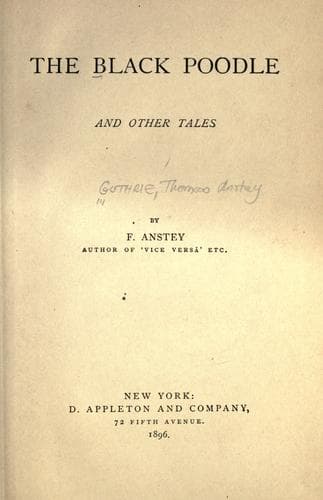
English fiction -- 19th century; Short stories, English
'Why, the fact is,' said the Colonel, heavily, gnawing his grey
moustache, 'we've not heard anything of him since: he's--he's run off!'
'Gone, Mr. Weatherhead; gone without a word!' said Mrs. Currie,
plaintively, as if she thought the dog might at least have left an
address.
'I wouldn't have believed it of him,' said the Colonel; 'it has
completely knocked me over. Haven't been so cut up for years--the
ungrateful rascal!'
'Oh, Uncle!' pleaded Lilian, 'don't talk like that; perhaps Bingo
couldn't help it--perhaps some one has s-s-shot him!'
'Shot!' cried the Colonel, angrily. 'By heaven! if I thought there was a
villain on earth capable of shooting that poor inoffensive dog,
I'd----Why _should_ they shoot him, Lilian? Tell me that! I--I hope you
won't let me hear you talk like that again. _You_ don't think he's shot,
eh, Weatherhead?'
I said--Heaven forgive me!--that I thought it highly improbable.
'He's not dead!' cried Mrs. Currie. 'If he were dead I should know it
somehow--I'm sure I should! But I'm certain he's alive. Only last night
I had such a beautiful dream about him. I thought he came back to us,
Mr. Weatherhead, driving up in a hansom cab, and he was just the same as
ever--only he wore blue spectacles, and the shaved part of him was
painted a bright red. And I woke up with the joy--so, you know, it's
sure to come true!'
It will be easily understood what torture conversations like these were
to me, and how I hated myself as I sympathised and spoke encouraging
words concerning the dog's recovery, when I knew all the time he was
lying hid under my garden mould. But I took it as a part of my
punishment, and bore it all uncomplainingly; practice even made me an
adept in the art of consolation--I believe I really was a great comfort
to them.
I had hoped that they would soon get over the first bitterness of their
loss, and that Bingo would be first replaced and then forgotten in the
usual way; but there seemed no signs of this coming to pass.
The poor Colonel was too plainly fretting himself ill about it; he went
pottering about forlornly--advertising, searching, and seeing people,
but all of course to no purpose, and it told upon him. He was more like
a man whose only son and heir had been stolen, than an Anglo-Indian
officer who had lost a poodle. I had to affect the liveliest interest in
all his inquiries and expeditions, and to listen to, and echo, the most
extravagant eulogies of the departed, and the wear and tear of so much
duplicity made me at last almost as ill as the Colonel himself.
Public-domain text, read in full here on John Shaqi.
Reviews
Reviews
No reviews yet
Be the first to share your thoughts on this work.
Join the Discussion
Join the discussion
Sign in to leave a comment or review.
Sign InorCreate an account