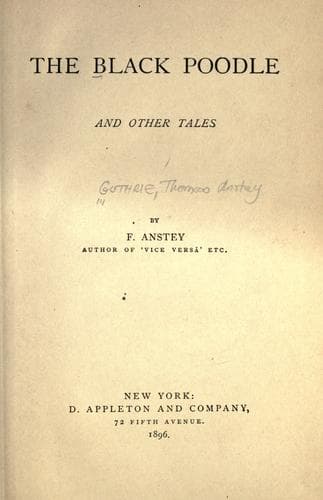
English fiction -- 19th century; Short stories, English
Then they were married, and, as Claudia played very nicely herself upon
the _tibiæ_, she got up musical evenings, when she played duets with the
flute-player, which Duilius, if he had only had a little more taste for
music, might have enjoyed immensely.
As it was, beginning to observe for the first time that the musician was
far from uncomely, he forbade the duets. Claudia wept and sulked, and
Claudia's mother said that Duilius was behaving like a brute, and she
was not to mind him; but the harmony of their domestic life was broken,
until the poor Consul was driven to take long country walks in sheer
despair, not because he was fond of walking, for he hated it, but simply
to keep the flute-player out of mischief.
He was now debarred from all other society, for his old friends had long
since cut him dead whenever he chanced to meet them. 'How could he
expect people to stop and talk,' they asked indignantly, 'when there was
that confounded fellow blowing tunes down the backs of their necks all
the time?'
Duilius had had enough of it himself, and felt this so strongly that one
day he took his flute-player a long walk through a lonely wood, and,
choosing a moment when his companion had played 'Id omnes faciunt' till
he was somewhat out of breath, he turned on him suddenly. When he left
the lonely wood he was alone, and somewhere in the undergrowth lay a
broken flute, and near it something which looked as if it might once
have been a musician.
The Consul went home and sat there waiting for the deed to become
generally known. He waited with a certain uneasiness, because it was
impossible to tell how the Senate might take the thing, or the means by
which their vengeance would declare itself.
And yet his uneasiness was counterbalanced by a delicious relief: the
State might disgrace, banish, put him to death even, but he had got rid
of slow music for ever; and as he thought of this, the stately Duilius
would snap his fingers and dance with secret delight.
All disposition to dance, however, was forgotten upon the arrival of
lictors bearing an official missive. He looked at it for a long time
before he dared to break the big seal and cut the cord which bound the
tablets which might contain his doom.
He did it at last, and smiled with relief as he began to read; for the
decree was courteously, almost affectionately, worded. The Senate,
considering (or affecting to consider) the disappearance of the
flute-player a mere accident, expressed their formal regret at the
failure of the provision made in his honour.
Then, as he read on, Duilius dashed the tablets into small fragments,
and rolled on the ground, and tore his hair, and howled: for the
Senatorial decree concluded by a declaration that, in consideration of
his brilliant exploits, the State thereby placed at his disposal two
more flute-players, who, it was confidently hoped, would survive the
wear and tear of their ministrations longer than the first.
Public-domain text, read in full here on John Shaqi.
Reviews
Reviews
No reviews yet
Be the first to share your thoughts on this work.
Elsewhere in the archive
Join the Discussion
Join the discussion
Sign in to leave a comment or review.
Sign InorCreate an account