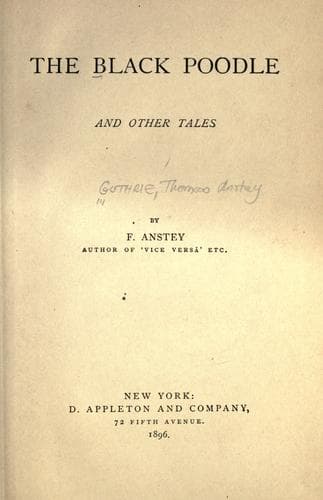
English fiction -- 19th century; Short stories, English
Of course he may have been really a fairy prince, and I should be sorry
to contradict any one who chose to say so. For he was only about three
inches high, he had rose-pink cheeks and bright yellow curling locks, he
wore a doublet and hose which fitted him perfectly, and a little cap and
feather, all of delicately contrasted shades of blue--and this does seem
a fair description of a fairy prince.
But then he was painted--very cleverly--but still only painted, on a
slab of prepared sugar, and his back was a plain white blank; while the
regular fairies all have more than one side to them, and I am obliged to
say that I never before happened to come across a real fairy prince who
was nothing but paint and sugar.
For all that he may, as I said before, have been a fairy prince, and
whether he was or not does not matter in the least--for he at any rate
quite believed he was one.
As yet there had been very little romance or enchantment in his life,
which, as far as he could remember, had all been spent in a long shop,
full of sweet and subtle scents, where the walls were lined with
looking-glass and fitted with shelves on which stood rows of glass jars,
containing pastilles and jujubes of every colour, shape, and flavour in
the world--a shop where, in summer, a strange machine for making cooling
drinks gurgled and sputtered all day long, and in winter, the large
plate-glass windows were filled with boxes made of painted silk from
Paris, so charmingly expensive and useless that rich people bought them
eagerly to give to one another.
The prince generally lay on one of the counters between two beds of
sugar roses and violets in a glass case, on either side of which stood a
figure of highly coloured plaster.
One was a major of some unknown regiment; he had an immense head, with
goggling eyes and a very red complexion, and this head would unscrew so
that he could be filled with comfits, which, though it hurt him
fearfully every time this was done, he was proud of, because it always
astonished people.
The other figure was an old brown gipsy woman in a red cloak and a
striped petticoat, with a head which, although it wouldn't take off, was
always nodding and grinning mysteriously from morning to night.
It was to her that the prince (for we shall have to call him 'the
prince,' as I don't know his other name--if he ever had one) owed all
his notions of Fairyland and his high birth.
'You let the old gipsy alone for knowing a prince when she sees one,'
she would say, nodding at him with encouragement. 'They've kept you out
of your rights all this time; but wait a while, and see if one of these
clumsy giants that are always bustling in and out doesn't help you;
you'll be restored to your kingdom, never fear!'
Public-domain text, read in full here on John Shaqi.
Reviews
Reviews
No reviews yet
Be the first to share your thoughts on this work.
Join the Discussion
Join the discussion
Sign in to leave a comment or review.
Sign InorCreate an account