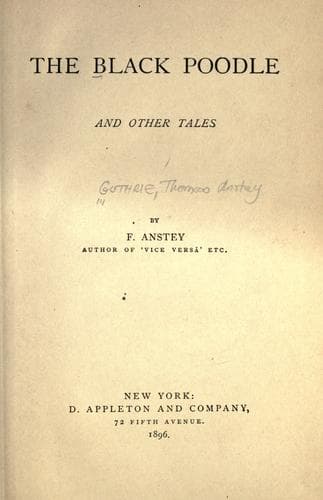
English fiction -- 19th century; Short stories, English
And then--I am sorry to have to tell what happened next, but this is a
true story and I must go on--then the prince saw Mabel's grey eyes
looking at him from under their long lashes with interest for the last
time, he saw two gleaming pearly rows closing upon him, he felt a sharp
pang, of grief as well as pain, as they crunched him up into small
pieces, and he slowly melted away and there was an end of him.
There is a beautiful moral belonging to this story, but it is of no use
to print it here, because it only applies to sugar princes--until Mabel
is quite grown up.
_THE RETURN OF AGAMEMNON._
[Illustration: It]
It was ten years since Agamemnon, the mighty Argive monarch, had left
his kingdom (somewhat suddenly, and after a stormy interview with the
Queen, as those said who had the best opportunities of knowing), with
the avowed intention of going to assist at the siege of Troy.
He had never written once since, but so many reports of his personal
daring and his terrible wounds had reached the palace that Clytemnestra
would often observe, with a touch of annoyance, that, if not actually
dead by that time, he must be nearly as full of holes as a fishing-net.
So that she was scarcely surprised when they broke the intelligence to
her one day that he really had gone at last, having fallen, fighting
desperately, against the most fearful odds, upon the Trojan plain; and
when, a little later, she formally announced to her faithful subjects
her betrothal to Ægisthus, her youngest and favourite courtier, _they_
were not surprised in their turn.
They told one another, with ribald facetiousness, that they had rather
expected something of the kind.
They were celebrating their Queen's betrothal day with the wildest
enthusiasm, for they were a simple affectionate people, and foresaw an
impetus to local trade. It had been but a dull time for Argos during
those weary ten years, and the city had become well-nigh deserted, as,
one by one, all her bravest and her best had left her, to seek, as they
poetically put it, 'a soldier's tomb.'
Several married men, in whom no such patriotic enthusiasm had ever been
previously suspected, found out that their country required their
services, left their wives and their little ones, and started for the
field of battle. There were many pushing Argive tradesmen, too, who
abandoned their business and sought--not ostentatiously, but with the
self-effacement of true heroism--the seat of war upon which their
sovereign had been sitting so long; while the real extent of their
devotion was seldom appreciated until long after their departure, when
it was generally discovered that, in their eagerness, they had left
their affairs in the greatest confusion.
And very soon almost the only young men left were mild, unwarlike
youths, who were respectable and wore spectacles, while the rest of the
male population was composed of equal parts of prattling infants and
doddering octogenarians.
Public-domain text, read in full here on John Shaqi.
Reviews
Reviews
No reviews yet
Be the first to share your thoughts on this work.
Join the Discussion
Join the discussion
Sign in to leave a comment or review.
Sign InorCreate an account