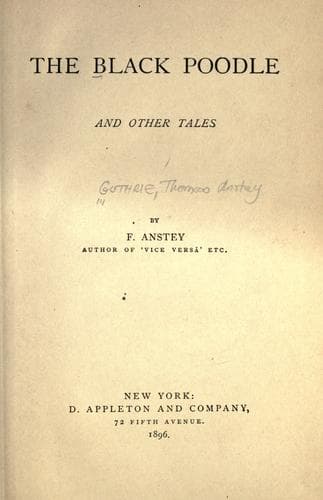
English fiction -- 19th century; Short stories, English
But he protested that she had not understood him. 'And if I have erred,
my love,' he suggested humbly, 'excuse me, but I cannot help thinking
that the means devised for my correction were unnecessarily severe!'
'They were nothing of the sort,' she said; 'you deserved it all--and
worse!'
Upon this Agamemnon made haste to assure her that she had shown a very
proper spirit, and he respected her the more for it. 'And now,' he put
it to her, 'why not let bygones _be_ bygones?' But Clytemnestra's reply
was that she would be quite willing to permit this when they _were_
bygones, which, at present, she added, they were very far from being.
The King was in despair, until beneficent nature came to his assistance;
a faint chirrup was heard from a neighbouring bush, a circumstance which
he turned to admirable account.
'You hear it?' he asked tenderly, 'the dulcet strain? Know ye the note?
Ah, Clytemnestra, 'tis the owl--the blithe and tuneful owl! Owls sang on
our bridal night--can you hear their melody now and be unmoved? No, I
did but wrong ye ... a tear trembles on that eyelash, a smile flickers
upon that lip! I am pardoned. Clytemnestra--wife, embrace me ... we both
have much to forgive!'
This speech (which was not unlike some he had heard in thrilling dramas
at the 'Hæmabronteion,' Corinth, where the prophetess Cassandra had been
greatly admired in her impersonations of persecuted and distracted
heroines) touched Clytemnestra's heart, in which, hard as it was, there
was a strain of sentiment--and she fell sobbing into her husband's arms.
And so all was forgotten and forgiven in the most satisfactory manner,
the Chorus (who had been considering themselves arrested until the
intellectual strain had proved almost too much for them) were released,
while it was found on inquiry that both Ægisthus and Cassandra were
missing, and no trace of either of them was ever found again; but it
was generally understood that, with a delicate unselfishness, they had
been unwilling to remain where their presence would lead to inevitable
complications.
And from that night--until the fatal day, some six short weeks
afterwards, when each, by an unfortunate oversight, partook of a mixture
which had been carefully prepared for the other--there was not a happier
royal couple in all Argos than Clytemnestra and Agamemnon.
_THE WRAITH OF BARNJUM._[1]
[Illustration: I]
I frankly admit, whatever may be the consequences of doing so, that I
was not fond of Barnjum; in fact, I detested him. Everything that fellow
said and did jarred upon me to an absolutely indescribable extent,
although I did not discover for some time that he regarded me with a
strange and unreasonable aversion.
Public-domain text, read in full here on John Shaqi.
Reviews
Reviews
No reviews yet
Be the first to share your thoughts on this work.
Join the Discussion
Join the discussion
Sign in to leave a comment or review.
Sign InorCreate an account