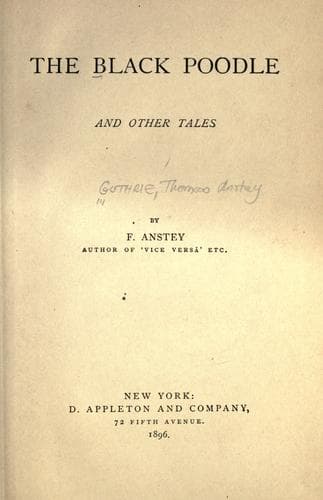
English fiction -- 19th century; Short stories, English
'I might work it up into something effective, certainly,' I admitted;
'and, by the way, if you are going to expire in my state-room, I ought
to know a little more about you than I do. There is time still before
the tender goes; you might do worse than spend it in coaching me in your
life's history.'
He gave me a few leading facts, and supplied me with several documents
for study on the voyage; he even abandoned to me the whole of his
travelling arrangements, which proved far more complete and serviceable
than my own.
And then the 'All-ashore' bell rang, and McFadden, as he bade me
farewell, took from his pocket a bulky packet. 'You have saved me,' he
said. 'Now I can banish every recollection of this miserable episode. I
need no longer preserve my poor aunt's directions; let them go, then.'
Before I could say anything, he had fastened something heavy to the
parcel and dropped it through the cabin-light into the sea, after which
he went ashore, and I have never seen nor heard of him since.
During the voyage I had leisure to think seriously over the affair, and
the more I thought of the task I had undertaken, the less I liked it.
No man with the instincts of a gentleman can feel any satisfaction at
rinding himself on the way to harrow up a poor young lady's feelings by
a perfectly fictitious account of the death of a poor-spirited suitor
who could selfishly save his reputation at her expense.
And so strong was my feeling about this from the very first, that I
doubt whether, if McFadden's terms had been a shade less liberal, I
could ever have brought myself to consent.
But it struck me that, under judiciously sympathetic treatment, the lady
might prove not inconsolable, and that I myself might be able to heal
the wound I was about to inflict.
I found a subtle pleasure in the thought of this, for, unless McFadden
had misinformed me, Chlorine's fortune was considerable, and did not
depend upon any marriage she might or might not make. On the other hand,
_I_ was penniless, and it seemed to me only too likely that her parents
might seek to found some objection to me on that ground.
I studied the photograph McFadden had left with me; it was that of a
pensive but distinctly pretty face, with an absence of firmness in it
that betrayed a plastic nature. I felt certain that if I only had the
recommendation, as McFadden had, of an aunt's dying wishes, it would not
take me long to effect a complete conquest.
And then, as naturally as possible, came the thought--why should not I
procure myself the advantages of this recommendation? Nothing could be
easier; I had merely to present myself as Augustus McFadden, who was
hitherto a mere name to them; the information I already possessed as to
his past life would enable me to support the character, and as it seemed
that the baronet lived in great seclusion, I could easily contrive to
keep out of the way of the few friends and relations I had in London
until my position was secure.
Public-domain text, read in full here on John Shaqi.
Reviews
Reviews
No reviews yet
Be the first to share your thoughts on this work.
Elsewhere in the archive
Join the Discussion
Join the discussion
Sign in to leave a comment or review.
Sign InorCreate an account