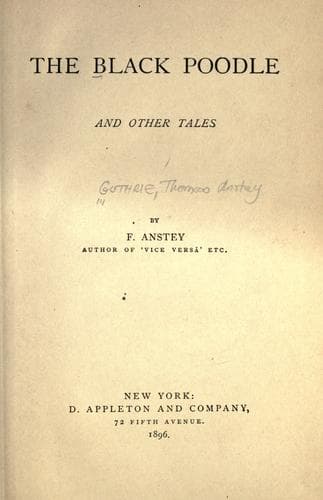
English fiction -- 19th century; Short stories, English
What harm would this innocent deception do to anyone? McFadden, even if
he ever knew, would have no right to complain--he had given up all
pretentions himself and if he was merely anxious to preserve his
reputation, his wishes would be more than carried out, for I flattered
myself that whatever ideal Chlorine might have formed of her destined
suitor, I should come much nearer to it than poor McFadden could ever
have done. No, he would gain, positively gain, by my assumption. He
could not have counted upon arousing more than a mild regret as it was;
_now_ he would be fondly, it might be madly, loved. By proxy, it is
true, but that was far more than he deserved.
Chlorine was not injured--far from it; she would have a suitor to
welcome, not weep over, and his mere surname could make no possible
difference to her. And lastly, it was a distinct benefit to _me_, for
with a new name and an excellent reputation success would be an absolute
certainty. What wonder, then, that the scheme, which opened out a far
more manly and honourable means of obtaining a livelihood than any I had
previously contemplated, should have grown more attractively feasible
each day, until I resolved at last to carry it out? Let rigid moralists
blame me if they will; I have never pretended to be better than the
average run of mankind (though I am certainly no worse), and no one who
really knows what human nature is will reproach me very keenly for
obeying what was almost an instinct. And I may say this, that if ever an
unfortunate man was bitterly punished for a fraud which was harmless, if
not actually pious, by a visitation of intense and protracted terror,
that person was I!
II.
After arriving in England, and before presenting myself at Parson's
Green in my assumed character, I took one precaution against any danger
there might be of my throwing away my liberty in a fit of youthful
impulsiveness. I went to Somerset House, and carefully examined the
probate copy of the late Miss Petronia McFadden's last will and
testament.
Nothing could have been more satisfactory; a sum of between forty and
fifty thousand pounds was Chlorine's unconditionally, just as McFadden
had said. I searched, but could find nothing in the will whatever to
prevent her property, under the then existing state of the law, from
passing under the entire control of a future husband.
After this, then, I could no longer restrain my ardour, and so, one
foggy afternoon about the middle of December, I found myself driving
towards the house in which I reckoned upon achieving a comfortable
independence.
Parson's Green was reached at last; a small triangular open space
bordered on two of its sides by mean and modern erections, but on the
third by some ancient mansions, gloomy and neglected-looking indeed, but
with traces on them still of their former consequence.
Public-domain text, read in full here on John Shaqi.
Reviews
Reviews
No reviews yet
Be the first to share your thoughts on this work.
Elsewhere in the archive
Join the Discussion
Join the discussion
Sign in to leave a comment or review.
Sign InorCreate an account